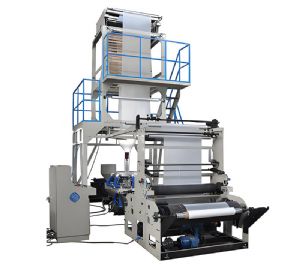
Complete resource covering working principle, bubble formation, die types (single-layer & multi-layer), cooling systems, technical specifications, industrial applications, and selection for packaging, agricultural, and industrial film industries.
A blown film machine (also known as a blown film extruder) is industrial equipment that melts thermoplastic resin pellets and extrudes them through a circular die to form a continuous thin-walled tube. The tube is inflated with air to create a large "bubble," which is then cooled, collapsed, and wound into flat film rolls. This process imparts balanced biaxial orientation, giving the film superior mechanical properties compared to cast film.
Key advantages: excellent tear strength, impact resistance, balanced MD/TD properties, ability to produce tube film (bags), lower capital cost than cast lines, and versatility for multi-layer co-extrusion.
The operating sequence involves eight core stages:
Critical control parameters: melt temperature, die gap, blow-up ratio (BUR), frost line height, and haul-off speed.
| Parameter | Typical Range |
| Film Width (flat) | 200 mm – 6000 mm |
| Line Speed | 10 – 200 m/min |
| Output Capacity | 30 – 1000 kg/h |
| Extruder Diameter | Φ30 mm – Φ200 mm |
| Die Diameter | Φ50 mm – Φ800 mm |
| Film Thickness Range | 0.008 mm – 0.25 mm |
| Blow-Up Ratio (BUR) | 1.5 : 1 – 5 : 1 |
| Layer Count | 1 – 9 layers |
| Material Types | LDPE, LLDPE, HDPE, PP, EVA, PA, PLA |
Packaging
Shrink film, stretch wrap, food bags, industrial liners, consumer goods pouches.
Agriculture
Greenhouse film, mulch film, silage wrap, crop covers.
Construction
Vapor barriers, insulation facings, protection sheets.
Medical
Sterile packaging, IV bags, surgical drapes (multi-layer barrier films).
Consumer Goods
Garment bags, grocery sacks, trash bags, shopping bags.
1. Output Requirements
Determine required kg/h based on production volume. Larger extruder diameters (≥Φ90mm) for high output (400+ kg/h).
2. Film Width & Thickness
Wide films (≥2000mm) require large die diameters and heavy-duty collapsing frames. Thin films (≤0.02mm) need precise air ring and gauge control.
3. Layer Structure
Single-layer for basic applications; 3-layer or 5-layer co-extrusion for functional films requiring barrier, seal, and structural layers.
4. Material Type
LLDPE/HDPE lines require high-pressure screws; PP needs higher melt temperatures; PA requires drying systems.
5. Automation & Control
Modern lines include automatic gauge control (AGC), IBC (internal bubble cooling), and thickness scanning.
6. Budget & ROI
European/Windmöller & Hölscher vs. Chinese/Kaixiang: trade-off between precision, longevity, and upfront cost.
Blown film vs cast film — which is better?
Blown film offers better mechanical strength (tear, impact) and balanced orientation; cast film provides superior clarity, gloss, and faster output. Choice depends on application: bags & liners → blown; packaging with high clarity → cast.
What is Blow-Up Ratio (BUR)?
BUR is the ratio of bubble diameter to die diameter. Higher BUR (3:1–5:1) increases transverse direction (TD) strength but reduces film thickness uniformity.
How do you clean a blown film die?
Use dedicated die cleaning compound or purge resin. For heavy deposits, disassemble the die and clean with brass tools and heat-safe solvent. Follow manufacturer's manual.
What is internal bubble cooling (IBC)?
IBC introduces cooled air inside the bubble to accelerate cooling, increasing line speed and improving thickness uniformity. Essential for high-output modern lines.
Can a blown film machine handle recycled materials?
Yes, but recycled resins require careful melt filtration (screen changers) and may affect bubble stability. A dedicated reclaim extruder with advanced degassing is recommended.