Blown film vs cast film (process difference)
The fundamental difference between blown film and cast film lies in the shaping and cooling methods. In blown film, the molten polymer is extruded through a circular die to form a tube, which is then inflated by internal air into a bubble, cooled by an air ring, collapsed, and wound flat. This process imparts biaxial orientation (both machine direction MD and transverse direction TD) because the film is stretched in two directions – by the haul-off (MD) and by bubble inflation (TD). In cast film, the molten polymer is extruded through a flat die (slot die) onto a highly polished, temperature-controlled chill roll, where it is quenched rapidly. There is no bubble; the film is cooled in a single direction, resulting in predominantly MD orientation, with very little TD orientation. This fundamental difference leads to distinct property profiles: blown film generally has higher tear resistance, impact strength, and puncture resistance due to biaxial orientation, while cast film excels in optical clarity, gloss, and thickness uniformity because of the rapid quenching on the chill roll. Blown film lines are typically simpler and less expensive for narrow widths, while cast film lines require higher investment but can produce very wide films with exceptional flatness.
The equipment configurations differ significantly. A blown film line includes an extruder, a circular die, an air ring, a bubble tower (for cooling and stabilization), a collapsing frame, nip rollers, and a winder. The bubble tower can be several meters tall. In contrast, a cast film line has an extruder, a flat die (usually with a flexible lip for thickness adjustment), a chill roll unit (with one or multiple rolls), an edge trim system, a thickness gauge, and a winder. The chill roll unit requires a precise temperature control system and a water chiller. Cast film lines are more compact horizontally but require very accurate die and roll alignment. The line speed for cast film is generally higher (up to 300-500 m/min) because cooling is more efficient, while blown film speeds are typically 200-300 m/min for thin films. The thickness range for blown film is wider (5-300 µm) compared to cast film (10-250 µm), though both cover most applications. The blown film process is more forgiving for high-viscosity resins and allows easier production of tubular films (bags). The cast film process is preferred for films requiring extreme clarity, such as overwrap for magazines and high-end food packaging, and for films that need consistent thickness profiles, like those used in coating and laminating.
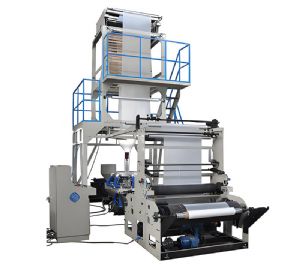
Blown Film Machine
Key property differences: blown film has a higher tear strength in both MD and TD (thanks to biaxial orientation), making it ideal for bags, liners, and heavy-duty packaging. Cast film has higher tensile strength in MD but lower in TD; it is stiffer and has lower haze (typically <2% haze vs 5-15% for blown film). Blown film has a more balanced shrink behavior, while cast film shrinks predominantly in MD. The optical properties of cast film are superior – higher gloss, lower haze, and better transparency – due to the chill roll's mirror finish and rapid cooling, which prevents crystallization. Blown film can achieve good clarity with mLLDPE and rapid cooling, but it rarely matches cast film. The seal strength is generally comparable, but cast film often has better hot tack. The production cost per kg is slightly lower for blown film for simple structures, but cast film can be more efficient for high-volume, wide-web applications. The choice between processes depends on the end-use: for bags, shrink wrap, and agricultural films, blown is preferred; for lamination, printing, and optical applications, cast is favored. The maintenance and operating costs are higher for cast film due to the chill roll and precise die maintenance.
Process control differences: in blown film, the bubble stability is critical; operators control BUR, frost line height, and air ring settings. In cast film, the die lip gap, chill roll temperature, and take-off speed are the main controls. Thickness variation in blown film is controlled by die bolt heating and air ring adjustments; in cast film, it is controlled by the die lip's thermal expansion bolts. The start-up of a blown film line is more labor-intensive (bubble initiation), while cast film starts up more easily. The scrap rate is generally higher for cast film during start-ups because of the die's sensitivity. Both processes can produce multi-layer films via co-extrusion, but blown film dies (stack type) are more common for 5+ layers. The environmental impact: blown film uses no water (air cooling only), while cast film requires significant water for chill roll cooling (recirculated). Energy consumption per kg is similar. Overall, the choice between blown and cast is a strategic decision based on product requirements, investment budget, and available floor space. Many converters operate both to serve different market segments.
