Advanced Integration of IBC and Automatic Winder for Productivity Boost in Blown Film Lines 2026
Adding an internal bubble cooling (IBC) system and an automatic turret winder to a blown film line can significantly boost productivity and reduce labor. IBC enhances cooling, allowing higher line speeds (20-40% increase) and better gauge uniformity. The automatic winder eliminates the need for manual roll changes, reducing downtime and improving roll quality. Together, they can increase overall output by 30-50% and reduce operator intervention by 50-70%. The IBC system includes a chiller, blower, manifold, and control system; it adds $30,000-$80,000 to the line cost. The automatic turret winder (with 2 or 3 stations, automatic transfer) adds $50,000-$150,000. The combined investment is significant, but the payback is typically 6-18 months due to increased output and labor savings. In summary, integrating IBC and an automatic winder transforms a standard line into a high-productivity system. The buyer should ensure the line's control system can coordinate the IBC and winder with the extruder and haul-off. The installation requires careful tuning of cooling and tension control. In conclusion, the combination of IBC and automatic winder is a proven upgrade for maximizing blown film line efficiency, offering a rapid return on investment through higher output and reduced manual labor.
The automatic winder's transfer mechanism must be synchronized with the line speed; a fast transfer (2-5 seconds) prevents film buildup and waste. The winder's tension control must be able to handle the higher speeds and maintain roll quality. The IBC system must be tuned to provide stable cooling at the higher speeds. The control system should include a recipe management to store settings for different products. In practice, the operator should monitor the winder's splice quality and the IBC's frost line stability. Regular maintenance of the winder's cut-off knife and the IBC manifold is essential. In conclusion, the integrated system of IBC and automatic winder is a powerful combination for converters seeking to boost productivity and reduce costs, making it a top priority for line upgrades and new purchases.
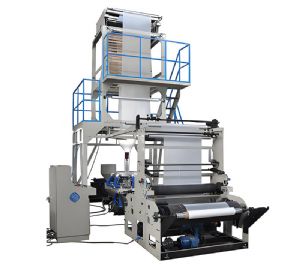
Blown Film Machine
Productivity gains: IBC: +20-40% line speed (same thickness). Auto-winder: eliminates downtime for roll changes (gain 5-10% uptime). Combined: +30-50% overall output. Labor reduction: fewer operators needed for winding. Quality improvement: better gauge uniformity (IBC) and consistent tension (auto-winder). Investment: IBC: $30k-$80k. Auto-winder: $50k-$150k. Total: $80k-$230k. Payback: typically 6-18 months. Integration: Control system must coordinate IBC and winder with line. Tuning required for optimal performance. In practice, many converters retrofit existing lines with these upgrades. In conclusion, advanced integration of IBC and automatic winder is a proven strategy for maximizing blown film line productivity, delivering significant gains in output and efficiency with a quick payback.
