Single-layer blown film machine
A single-layer blown film machine is the simplest type of blown film extrusion line, featuring one extruder, one die, and one cooling system to produce film made from a single polymer or blend. It is the most economical and easy-to-operate solution for applications where barrier or high-performance properties are not required. Typical applications include garbage bags, grocery sacks, produce bags, liners, shrink wrap (basic), and agricultural mulch film (with additives). The machine consists of a single-screw extruder (usually 45-90 mm diameter), a circular die (100-400 mm diameter), an air ring, a collapsing frame, nip rollers, and a winder. The control system is relatively simple, with a few temperature zones and basic speed controls. Because there is only one melt stream, start-up is quick, and changeovers between different materials or colors are straightforward, though purging is still required. The capital investment is significantly lower than multi-layer lines – typically 30-50% of the cost of a 3-layer line of similar output. This makes single-layer machines attractive for small to medium converters, or for product lines that do not require complex film structures.
The main limitation of a single-layer machine is that it cannot combine incompatible polymers to achieve properties like oxygen barrier (EVOH) or high-temperature resistance (PA) with sealability. All properties must come from a single resin or blend, which often involves trade-offs – for example, adding LLDPE improves tear strength but reduces clarity; adding HDPE increases stiffness but reduces impact. Blending can help, but it never matches the performance of a multi-layer structure with distinct layers. Also, single-layer films have uniform composition, so any recycled content added will affect surface properties (like sealability) and may cause odor or color issues. Therefore, single-layer lines are best for commodity films where cost is the primary driver. However, they can still produce high-quality film with good clarity and mechanical properties if the material and process parameters are well optimized. Some single-layer lines are used for specialized products like shrink labels or overwrap, using metallocene LLDPE for superior properties.
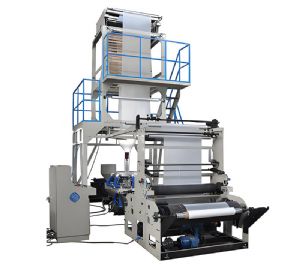
Blown Film Machine
Key technical specifications for a single-layer machine: extruder screw L/D typically 28:1 to 32:1, die diameter chosen to achieve desired lay-flat width, output capacity up to 300 kg/h for large models. The line speed is usually lower than multi-layer lines of similar output because the single extruder must handle all the throughput, but can still reach 150 m/min for thin films. The cooling system is often a standard air ring without IBC (though IBC can be added as an upgrade). The thickness gauge is optional but recommended; automatic gauge control is usually not installed because of cost, though basic die bolt control may be present. The winder is typically a single or turret type. Maintenance is simpler due to fewer components. The machine footprint is smaller, requiring less floor space and lower ceiling height because the bubble is smaller. Power consumption per kg is slightly higher than multi-layer lines because the single screw may need to run at higher torque to process the material, but overall energy cost is lower due to smaller motor sizes.
When selecting a single-layer blown film machine, consider the target film thickness range, width, and output. Choose a screw design matched to the primary resin (e.g., barrier screw for LLDPE/HDPE). The die diameter and BUR range must accommodate the desired lay-flat width. If you plan to process recycled material, consider a screen changer with higher capacity and possibly a vented screw to remove volatiles. Evaluate the supplier's after-sales support and availability of spare parts. Although single-layer is simpler, it still requires skilled operation to achieve consistent quality – controlling melt temperature, cooling, and thickness. Upgrading to a single-layer line with IBC and AGC can significantly improve productivity and quality, making it competitive with some multi-layer lines for non-barrier applications. Overall, the single-layer blown film machine is a reliable, cost-effective entry into film extrusion, ideal for startups or manufacturers with undemanding product requirements. Its simplicity and low operating costs make it a popular choice worldwide for commodity film production.
