Micro-layer blown film system
A micro-layer blown film system is an advanced co-extrusion technology that produces films with dozens or even hundreds of alternating micro-layers, each being only a few microns or sub-microns thick. Unlike conventional 3-, 5-, or 7-layer systems, micro-layer systems use specialized feed blocks and die designs that split and recombine melt streams to multiply the number of layers. For example, a 3-layer initial feed can be split into 9, 27, or 81 layers through a series of layer multipliers. The result is a film with a highly laminated structure that dramatically improves mechanical properties (tear strength, impact, puncture) and barrier performance (oxygen, moisture) due to the "brick-wall" effect of numerous interfaces. This technology is used for ultra-high-performance films in automotive, medical, and specialty packaging where standard multi-layer films are insufficient. The system typically requires 3-5 extruders, a feed block with layer multiplication modules, and a specially designed die that can handle the complex melt flow without interfacial instability.
The principle of micro-layer formation relies on the fact that alternating layers of different polymers create a tortuous path for gas molecules, enhancing barrier, and the numerous interfaces impede crack propagation, increasing toughness. The layer thickness is controlled by the multiplication ratio and the overall output. For example, a 3-layer feed block with a 3:1 multiplication factor produces 9 layers; cascading multipliers can reach 729 layers. The individual layer thickness can be as low as 10-50 nm, approaching nanoscale. The equipment must have extremely precise temperature and flow control because even minor variations cause layer rupture or merging. The polymers must have matched viscosities and elasticity to avoid interfacial waves; this limits material combinations. Typically, the system uses PE and PA or EVOH for barrier, or PE and PP for mechanical synergy. The die is a multi-manifold type with optimized geometry to distribute the micro-layer stack uniformly around the circumference. The cooling system must be highly efficient to freeze the structure quickly, preventing coarsening of layers. The line speed is moderate (30-80 m/min) because of the complex flow and the need for sufficient residence time in the multipliers.
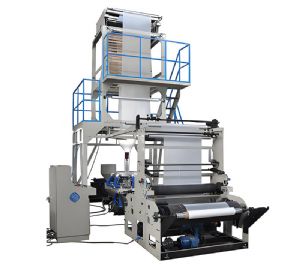
Blown Film Machine
Key advantages of micro-layer films: dramatic improvement in barrier properties – a 27-layer film can have 50% better oxygen barrier than a 3-layer film with same total barrier material; enhanced mechanical properties – tear strength can increase 2-3 times, and impact resistance is significantly higher; also, optical properties can be improved by reflection and refraction effects (the film can appear iridescent). The system allows using less expensive barrier resin because the micro-layering effect multiplies the barrier effect per unit thickness. Applications: food packaging with extended shelf life, medical blister packs, automotive interior films, and high-performance shrink films. The investment is high due to the complex feed block and die, and the need for advanced controls. The system is typically custom-built by specialized suppliers. Operational challenges: cleaning the multipliers is difficult; purging with appropriate compounds is essential. Layer uniformity must be monitored; online NIR or Raman spectroscopy can measure layer thickness distribution. The die temperature must be kept within ±1°C; any deviation causes layer merging.
Economic and technical feasibility: micro-layer systems are not for every converter. They are best suited for high-volume, high-margin specialty films. The capital cost can be 2-3 times a standard 5-layer line. However, the material savings (using less barrier resin) can offset the investment over time. The process is more sensitive to resin changes; each lot must be tested. The equipment requires highly skilled operators and engineers. Research is ongoing to apply micro-layer technology to biodegradable films to enhance their performance. The trend is toward in-line layer multiplication with real-time quality feedback. Overall, the micro-layer blown film system represents the forefront of blown film innovation, enabling films with properties that were previously impossible. While complex, it offers a path to sustainable packaging by using less material for the same performance. Converters who invest in this technology gain a competitive edge in premium markets, but must be prepared for the higher operational demands and maintenance costs. The future may see wider adoption as costs decrease and material knowledge improves.
