Extrusion process parameter optimization
Extrusion process parameter optimization is the systematic adjustment of machine settings to achieve the best balance of film quality, output, and energy efficiency. In blown film, the key parameters include melt temperature, screw speed, BUR, frost line height, cooling air flow, haul-off speed, and internal pressure (for IBC). Each parameter interacts with others, making optimization a multi-variable challenge. The goal is to find the combination that yields the desired film properties (tensile, tear, clarity, thickness tolerance) at the highest possible output with minimal scrap. Traditional trial-and-error is inefficient; modern optimization uses Design of Experiments (DOE) and statistical analysis. DOE involves varying multiple parameters simultaneously in a structured way (e.g., central composite design) to identify main effects and interactions. For example, you might test melt temperature at 190, 200, 210°C and BUR at 2.5, 3.0, 3.5, and measure the resulting film haze, tear strength, and thickness variation. Software can then generate a response surface to find the optimal settings. Many blown film lines now have built-in data logging that captures all parameters, enabling historical analysis. The first step is to define the quality targets: e.g., haze <8%, tear strength >80 g/µm, thickness tolerance ±4%. Then, using a fractional factorial design, reduce the number of experiments. After running the trials, analyze the data to identify significant parameters. Typically, BUR and cooling rate have the largest effect on mechanical and optical properties; melt temperature affects flow and degradation. The optimal settings often involve a trade-off: higher BUR improves strength but increases haze; higher melt temperature improves clarity but may degrade strength. The optimized parameters should be documented as a "recipe" for each product. Regular re-optimization is needed when resin batches change.
Practical tips for on-the-fly optimization: use a stepwise approach – start with a known baseline (e.g., from supplier recommendation), then adjust one parameter at a time while keeping others constant. For instance, increase BUR by 0.2 and measure tear and haze; if tear improves and haze is acceptable, continue. Similarly, adjust cooling air flow to lower frost line and observe gauge variation. Use a thickness gauge to monitor uniformity; if gauge improves, the change is beneficial. Also, consider the energy cost – increasing screw speed raises output but also shear heating; lowering barrel temperatures can compensate. The screw speed and haul-off speed must be synchronized; their ratio determines the MD orientation. A common optimization approach is to maximize output while keeping film properties within specification – this often involves pushing cooling to its limit (with IBC) and increasing screw speed until melt temperature reaches degradation threshold. Another method is to use process capability analysis (Cpk) to ensure the process is stable and within tolerance. Advanced lines have auto-optimization algorithms that adjust parameters based on real-time gauge and quality feedback – these are known as advanced process control (APC). APC can continuously fine-tune settings to maintain optimal performance despite variations in raw material or ambient conditions. However, APC requires accurate sensors and robust control logic. In summary, extrusion process parameter optimization is a data-driven approach that improves consistency, reduces scrap, and increases profitability. It requires a combination of statistical tools, operator experience, and sometimes advanced software. Investing time in optimization pays off through better product quality and lower production costs.
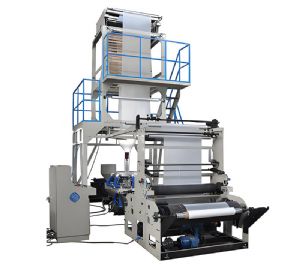
Blown Film Machine
Key parameters and their effects: Melt temperature – increases clarity but decreases strength and may cause degradation if too high. Screw speed – increases output but raises melt temperature; optimal speed balances output and melt quality. BUR – increases TD strength and width but reduces clarity and stability. Frost line height – lower height gives higher strength but higher haze; higher gives clarity but lower strength. Cooling air flow – affects frost line; more flow lowers height and increases speed capability. Haul-off speed – inversely affects thickness; higher speed reduces thickness for given output. IBC air flow – enhances cooling, allowing higher speed; must be balanced with external air. When optimizing, start with the most influential parameters (BUR and cooling) because they have the largest effect on properties. Use a Response Surface Method (RSM) with 3 levels per factor. Always replicate experiments to measure variability. After finding the optimal region, confirm with verification runs. Document the final settings and implement a control chart to monitor key parameters. Train operators on the optimized settings and why they are chosen. Regular review (quarterly) of parameter performance against product specs ensures continuous improvement. In conclusion, systematic optimization turns the blown film line from a black art into a predictable, efficient process. It is a core competency for competitive film production.
