PP blown film equipment
PP blown film equipment is a specialized blown film line designed to process polypropylene (PP) resins, which have a higher melting point (160-170°C) and higher stiffness than PE. PP films are used for applications requiring heat resistance, high clarity, and good moisture barrier, such as textile packaging, food packaging (biscuits, snacks), medical packaging, and shrink labels. However, PP is more difficult to process in blown film due to its narrow processing window, high melt elasticity, and susceptibility to thermal degradation. The equipment must have precise temperature control, a screw designed for PP (usually a barrier screw with high compression ratio 3.5:1 to 4.5:1), and a die capable of handling higher melt temperatures (210-240°C). The barrel heating zones must be powerful to reach 240°C, and cooling is critical to prevent degradation. The die gap is typically 0.8-1.5 mm. The air ring must provide rapid and uniform cooling because PP crystallizes quickly; the frost line is usually lower (300-500 mm) compared to PE. The BUR is limited to 2.0-2.8 because higher BUR causes bubble instability and excessive orientation that reduces impact strength.
One of the key challenges in PP blown film is the melt fracture (sharkskin) due to high shear rate. To mitigate this, the equipment often includes a melt pump to reduce pressure fluctuations and a die with a smooth surface. The screw should have a mixing section to homogenize temperature. PP also requires a drying step if using grades with high moisture? PP is not hygroscopic, but some grades with additives may need drying. The line speed is typically moderate (40-100 m/min) because PP films are usually thicker (30-100 µm) for structural applications. The film's mechanical properties – high tensile strength, low elongation, good impact at low temperatures (if using impact copolymer) – make PP suitable for bags that need stiffness. Applications include: cement bags, textile bags (woven PP coating), food overwrap (biscuits), shrink labels (BOPP alternative), and medical sterilization packaging (requires high-temperature resistance). The equipment can also produce oriented PP films by using a higher draw ratio, but full orientation is usually done in a separate line (BOPP). For blown film, the orientation is moderate.
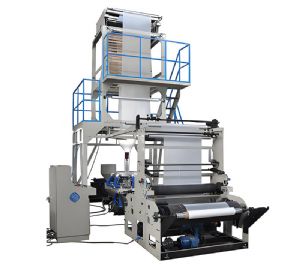
Blown Film Machine
Key parameters for PP blown film equipment: melt temperature set at 220-230°C; too low causes poor melt quality, too high degrades PP (yellowing, gels). The screw speed should be moderate to avoid excessive shear heating. The BUR is selected to achieve the required width; for PP, BUR 2.0-2.5 is common. The cooling air must be chilled (10-15°C) to accelerate crystallization and improve clarity. The film's haze and gloss are excellent if cooling is uniform. Additives like nucleating agents can improve clarity and stiffness. The die must have a land length that provides adequate pressure drop to avoid melt fracture. The winder must handle stiff film; surface winders are often used. The line can also produce PP/PE blends for improved low-temperature performance. Maintenance: PP leaves little residue, but the die must be cleaned regularly to prevent deposits. The screw should be inspected for wear from abrasive additives. The equipment is more expensive than PE lines due to higher-grade components and tighter tolerances.
Market and operational insights: PP blown film is growing due to its recyclability and heat resistance. The equipment is often used in converting plants that produce bags for agriculture, construction, and food. The operator must be skilled in temperature management; fluctuations cause gauge bands and haze. The use of a gravimetric feeder ensures consistent feed rate. For high-clarity films, the air ring must be perfectly symmetric. The line can be upgraded with IBC to increase output, but careful control is needed to avoid quenching too fast. The energy consumption is higher because of the higher temperatures. PP blown film equipment is a niche but essential segment, serving markets that cannot use PE due to temperature limitations. With advances in PP resins (metallocene PP, high melt strength PP), the processing window has widened, making PP blown film more accessible. Overall, this equipment enables production of high-performance films that compete with cast PP and BOPP in many applications, offering the advantage of lower capital cost and simpler line than oriented processes.
