Corona surface treatment unit
Corona surface treatment is a common in-line process used to increase the surface energy of plastic films, making them receptive to printing, coating, or lamination. The unit consists of a high-frequency generator, an electrode (typically a ceramic-covered metal bar), and a grounded roll (covered with silicone or rubber). As the film passes between the electrode and the grounded roll, a high-voltage, high-frequency discharge (corona) creates an ionized air plasma that oxidizes the film surface, introducing polar groups. This raises the surface tension (dyne level) from about 30-32 dyne/cm (untreated PE/PP) to 38-44 dyne/cm or higher, which is required for good ink adhesion. The treatment is applied in-line, usually after the nip rollers or before the winder. The intensity of treatment is controlled by the generator power (watts) and the line speed – higher power or lower speed gives higher treatment level. The dyne level must be monitored regularly using dyne test pens or inks. Over-treatment can cause surface degradation (smoke, haze), while under-treatment leads to poor adhesion. The treatment effect also decays over time, so printed films should be processed soon after treatment. The corona unit should be equipped with an ozone extraction system, as ozone is a byproduct and can be harmful. The grounded roll must be clean and smooth – any contamination causes uneven treatment. The electrode gap is typically 1-3 mm; too close causes arcing, too far reduces efficiency.
Operation of the corona unit involves setting the generator power based on the required dyne level and line speed. As a rule of thumb, power (W) = (speed in m/min) × (width in m) × (target dyne increment) / a constant. For example, for 150 m/min, 1.2 m width, targeting 42 dyne from 32 (increment 10), power ≈ 150×1.2×10/10 = 1800 W. But actual settings depend on the electrode design and film type. The operator should start at a moderate power and increase gradually while checking dyne level. The treatment should be uniform across the width; any streaks indicate uneven electrode or roll condition. The corona unit often has an automatic power control that adjusts power with line speed to maintain constant treatment level. The system also includes a cooling fan for the electrode. Regular maintenance: clean the electrode and roll with a non-abrasive cleaner to remove polymer residues; check for pinholes or cracks in the ceramic coating; replace the electrode if worn. The ozone extraction duct should be clear. The dyne level should be checked every shift using test pens – if it drops, increase power or clean the roll. For multi-layer films, treatment is usually applied to the outer layer that will be printed. Some corona units are used for both sides with dual electrodes. In summary, the corona surface treatment unit is a simple but vital device for adding value to blown film by enabling printing and lamination. Proper setting and maintenance ensure consistent adhesion quality and reduce rejects. With the trend toward digital printing, corona treatment remains essential for film converters.
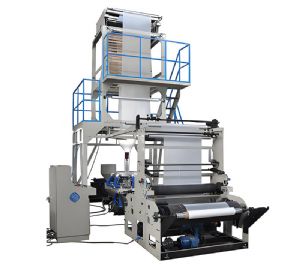
Blown Film Machine
Troubleshooting common issues: – Low dyne level: increase power, clean the roll, check electrode gap, or replace electrode. – Uneven treatment: check roll cleanliness, electrode alignment, and film tension – if film wrinkles, it causes contact variation. – Sparking or arcing: reduce power, increase gap, check for moisture or contamination. – Ozone smell: ensure extraction is working. – Film discoloration: over-treatment – reduce power or increase speed. – Treatment decay: treat as close to printing as possible. For demanding applications (e.g., solvent-based inks), a higher dyne level (44-48) may be needed, which requires more power and may cause film degradation. In such cases, use a flame treater instead. Always follow the manufacturer's guidelines for maximum power to avoid damaging the film. In conclusion, the corona unit is a low-maintenance, high-impact tool that significantly expands the usability of blown film. Invest in a quality generator and electrode, and train operators on dyne level testing. With proper care, it will provide years of reliable service.
