Heavy-duty (HD) film blowing machine
A heavy-duty (HD) film blowing machine is a robust, high-capacity blown film line specifically engineered to produce thick, strong films typically ranging from 80 to 300 microns, with lay-flat widths often exceeding 2 meters. These machines are built with larger extruders (diameters 120-200 mm), higher torque gearboxes, and more powerful motors to handle the high melt flow required for heavy films. The cooling system is oversized – with high-capacity air rings and often IBC – to remove the substantial heat from thick bubbles. The die diameters are large (400-800 mm) to accommodate wide film widths without excessive BUR. The collapsing frame and nip rollers are heavy-duty, designed to support the weight and tension of thick film. Applications include heavy-duty sacks (for cement, chemicals, fertilizers), industrial liners, geomembranes, construction vapor barriers, and tarpaulins. The line speed is typically lower (10-40 m/min) because thick film requires longer cooling times and slower haul-off to maintain uniformity.
The design of an HD film blowing machine prioritizes durability and continuous operation. The extruder barrel is often bimetallic with a wear-resistant liner to process abrasive materials like recycled resins or filled compounds. The screw is a high-compression barrier type with a length-to-diameter ratio of 30:1 or more, ensuring complete melting and homogenization of high-viscosity melts. The screen changer has a large filtration area to minimize pressure drop and frequency of changes. The die is often a stack type with multiple heating zones to maintain uniform temperature across the large circumference. The air ring is dual-lip with high-velocity blowers, and IBC is almost standard to boost cooling efficiency. The winder is a heavy-duty turret type capable of handling rolls weighing up to 1000 kg or more. The control system includes advanced AGC to maintain thickness tolerance within ±5% despite the high gauge. Safety features like melt pressure relief and emergency stops are mandatory due to the high pressures involved.
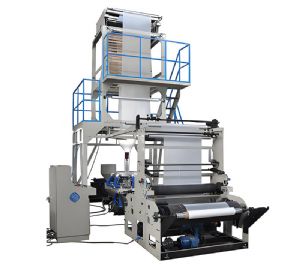
Blown Film Machine
Key technical specifications for HD film blowing machines: output capacity typically 300-1000 kg/h, motor power up to 400 kW, film thickness range 80-300 µm, lay-flat width up to 4 m, and line speed up to 60 m/min for thinner end of range. The screw speed is lower (40-80 RPM) to avoid excessive shear heating. The melt temperature is set higher (200-240°C) to reduce viscosity and ease flow. The BUR is moderate (2.5-3.5) to provide balanced orientation without sacrificing stability. The frost line height is kept low (300-500 mm) to ensure rapid solidification of the thick melt. The film's mechanical properties – high tensile strength (MD and TD), excellent puncture resistance, and low creep – are critical for industrial uses. Additives like UV stabilizers, antioxidants, and antistatic agents are often incorporated to meet specific environmental requirements. The machine's energy consumption is significant; energy recovery systems (e.g., heat from barrel cooling) are increasingly used to reduce operating costs. Maintenance includes regular lubrication of heavy bearings, inspection of gearbox oil, and cleaning of the large die surface.
Operational considerations: HD film lines are often run 24/7 to amortize the high capital investment. Grade changes are infrequent but time-consuming due to the large melt volume. Purging requires high-quality compounds and careful temperature ramping. The bubble stability is critical – any oscillation causes gauge bands that are unacceptable for thick films used in high-strength applications. Operators must monitor internal air pressure, cooling air flow, and nip roll pressure closely. The film's flatness is important for downstream converting; a collapsing frame with adjustable angles helps. The winder must maintain constant tension to avoid stretching or telescoping. Regular calibration of the thickness gauge is essential because thick film absorbs more radiation, requiring compensation. The line can also process recycled content (up to 50%) with proper filtration, reducing material cost. Overall, heavy-duty film blowing machines are the backbone of the industrial film sector, providing the strength and durability required for heavy-duty packaging and construction uses. Their robust construction and high output justify the investment, and with proper maintenance, they offer a long service life of 15-20 years. Manufacturers are also integrating Industry 4.0 features for predictive maintenance, monitoring vibration and temperature to preempt failures.
