Advanced Line Speed Control and Its Impact on Thickness, Orientation, and Output 2026
Line speed, or haul-off speed, is the rate at which the film is pulled from the bubble by the nip rollers, measured in meters per minute (m/min). It is the primary means of controlling film thickness for a given extruder output: thickness is inversely proportional to line speed. For example, if the extruder output is constant, doubling the line speed halves the thickness. Therefore, line speed is adjusted to achieve the target film thickness. However, line speed also affects the machine direction (MD) orientation: higher speed results in higher MD stretch (draw ratio), which increases MD tensile strength but reduces tear resistance and increases shrink. Therefore, the line speed must be set to achieve the desired balance of MD and TD properties (the latter controlled by BUR). The line speed is also limited by the cooling system: if the speed is too high, the film does not have enough time to cool, and the frost line rises, leading to bubble instability. The maximum line speed is determined by the cooling capacity and the resin's melt strength. In practice, the line speed is set as high as possible to maximize output, but it must be reduced if quality (e.g., gauge uniformity) deteriorates. The line speed is controlled by the nip roll drive, which is typically a servo motor with a VFD. The speed setpoint is entered on the HMI, and the drive maintains it via encoder feedback. The line speed is synchronized with the extruder speed and the winder speed to maintain constant tension. In summary, line speed is a critical process variable that affects thickness, properties, and output. Its optimization requires balancing the need for high output with the constraints of cooling and quality.
The relationship between line speed and MD orientation can be quantified by the draw-down ratio (DDR), which is the ratio of line speed to the melt exit speed at the die. The melt exit speed is determined by the extruder output and the die gap. A higher DDR increases the MD stretch ratio, aligning the polymer chains in the MD, which increases tensile strength and stiffness but decreases tear strength and impact resistance. For balanced film properties, the DDR is typically kept in the range of 5 to 15, and the product of DDR and BUR is around 10-15. The line speed also affects the frost line height: increasing line speed reduces the residence time of the film in the cooling zone, so the frost line moves upward (higher) unless cooling is increased. Therefore, when increasing line speed, the cooling air flow must be increased to maintain the frost line at the setpoint. The line speed also affects the winder; higher speed requires faster roll changes and may exceed the winder's capacity. In multi-layer lines, the line speed is common to all layers; the individual extruder outputs must be adjusted to maintain the layer ratios as the speed changes. In summary, line speed is not an independent variable; it interacts with extruder output, cooling, and winder. A change in line speed requires coordinated adjustments of other parameters. Therefore, line speed control is often part of a master speed setpoint that scales all drives proportionally. This simplifies operation and maintains consistency. In conclusion, line speed is a powerful control variable that directly affects film thickness and properties. Its optimization is essential for achieving high quality and productivity. By understanding its effects and interactions, operators can set the line speed to maximize output while meeting product specifications.
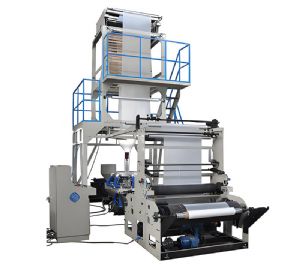
Blown Film Machine
Key relationships: – Thickness ∝ 1 / Line Speed (at constant output) – MD orientation ∝ Line Speed (higher speed = higher DDR) – Output (kg/h) = Line Speed × Width × Thickness × Density × 60 / 1e6 – Frost line height increases with Line Speed (if cooling unchanged) – Winder speed must match Line Speed. Control strategies: – Use master speed setpoint to coordinate all drives. – Adjust cooling air flow when changing speed. – Use AGC to maintain thickness during speed changes. – Monitor melt pressure to ensure extruder output matches speed. – Ensure winder has sufficient capacity for new speed. – For high-speed lines, use automatic roll transfer to avoid stopping. In conclusion, line speed is a fundamental parameter in blown film production. By carefully controlling it and its interactions with other variables, converters can achieve high output, consistent thickness, and balanced film properties. Regular monitoring and optimization of line speed contribute to overall process efficiency and product quality.
