Advanced 7-Layer High-Barrier Film Line: Multi-Barrier Integration and Process Complexity 2026
A 7-layer high-barrier film line is a state-of-the-art co-extrusion system that enables the production of films with exceptional barrier properties by combining two or more barrier layers (e.g., EVOH and PA) along with multiple tie and functional layers. A typical 7-layer structure might be: sealant / tie / EVOH / tie / PA / tie / outer. This configuration provides oxygen barrier (EVOH) and moisture barrier/puncture resistance (PA), making it ideal for demanding applications like retortable pouches, vacuum packaging, and medical packaging. The EVOH layer provides low oxygen transmission, while the PA layer provides mechanical strength and aroma barrier. The multiple tie layers are necessary to bond the incompatible polymers. The line requires seven extruders, each with its own temperature profile, and a complex die (typically multi-manifold) to combine the layers. The die must have independent temperature control for each layer, as EVOH (190-220°C) and PA (230-250°C) have different processing temperatures. The line speed is often lower than that of simpler lines because of the thicker total gauge and the need for precise cooling. The investment cost is high, but the films command premium prices. In summary, the 7-layer line is the pinnacle of blown film technology, enabling the production of films that combine multiple functionalities. Its complexity requires highly skilled operators and robust control systems. The layer structure can be customized for specific applications, offering flexibility to converters who serve high-end markets.
The integration of multiple barrier layers creates challenges in layer stability and adhesion. The viscosity of EVOH and PA must be matched with the tie layers to prevent interfacial instability. The die design must distribute each layer uniformly; multi-manifold dies are essential for 7 layers. The feed block approach is rarely used because of viscosity mismatches. The die's thermal management is critical; the different zones must be maintained precisely. The thickness of each barrier layer must be controlled individually; NIR gauging with layer-specific calibration is used. The overall film thickness is typically 80-200 µm, with barrier layers totaling 10-20 µm. The processing window is narrow; any deviation can cause delamination or barrier failure. In practice, the line is dedicated to a limited number of products to minimize changeover time. The operator must monitor the melt pressure and temperature of each extruder and the die zones. Regular maintenance of the die and feed block is essential to prevent degradation residues. In summary, the 7-layer line offers unmatched performance but demands meticulous control. The integration of multiple barriers and tie layers is a complex engineering challenge that requires advanced machinery and skilled operation. The benefits, however, are films with exceptional shelf-life and mechanical properties, suitable for the most demanding packaging applications. In conclusion, the
7-layer high-barrier film line represents the frontier of blown film technology, enabling converters to offer premium products that meet the strictest requirements of the food, medical, and industrial sectors.
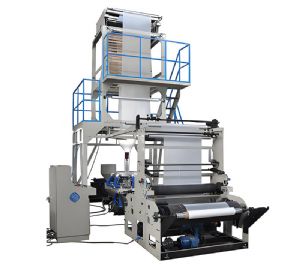
Blown Film Machine
Typical 7-layer structures: – Symmetrical: A/B/C/B/D/B/E (with two barrier layers and tie layers). – Asymmetrical: sealant/tie/EVOH/tie/PA/tie/outer. – For retort: PP-based sealant, tie (PP-g-MAH), EVOH, tie, PA, tie, outer PP. Layer thickness distribution: – Sealant: 10-20% – Tie layers: 5-10% each – EVOH: 5-10% – PA: 10-20% – Outer: 20-30% Key process challenges: – Viscosity matching: EVOH and PA have different rheology; tie layers must bridge. – Temperature management: die must maintain different temperatures for each layer. – Cooling: thick total gauge requires high cooling capacity; IBC is essential. – Gauge control: layer-specific AGC with NIR. – Adhesion: tie layers must bond to both EVOH and PA; adhesion testing is critical. In practice, the 7-layer line is often used for high-value products where cost is less of a concern than performance. The line's complexity means that changeovers are time-consuming; therefore, production scheduling is important. The operator must be highly trained and have a deep understanding of polymer processing. In conclusion, the 7-layer line is a strategic asset for converters targeting premium markets. Its successful operation depends on a combination of advanced equipment, skilled personnel, and robust process control.
