LDPE/LLDPE film extruder
An LDPE/LLDPE film extruder is a blown film line designed to process low-density polyethylene (LDPE) and linear low-density polyethylene (LLDPE), either neat or blended. These are the most common resins in the flexible packaging industry, offering excellent flexibility, clarity, sealability, and toughness. LDPE is highly branched, giving good optical properties (high clarity) and easy processing, but lower tensile strength. LLDPE has linear chains with short branches, providing higher tensile strength, tear resistance, and puncture resistance, but it is more difficult to process due to higher viscosity and melt fracture tendency. Most commercial films use blends of LDPE (10-50%) and LLDPE to balance processability and mechanical properties. The extruder for these materials typically has a general-purpose screw with a compression ratio of 2.5-3.5:1 and L/D of 28-32:1. The barrel temperature profile is moderate: feed zone 150-170°C, compression 180-200°C, metering 190-210°C. The die temperature is similar, around 190-210°C. The machine can produce films from 15 µm to 200 µm, with line speeds up to 250 m/min for thin films.
The key advantage of LDPE/LLDPE film extruders is their versatility – they can produce a wide range of films: shrink wrap, stretch wrap (with LLDPE), agricultural mulch, garbage bags, liners, and food packaging. The screw design must handle the shear sensitivity of LLDPE; a barrier screw with a mixing section is recommended to achieve good melt homogeneity and avoid melt fracture. The die gap is typically 1.0-2.0 mm. The air ring cooling is moderate; IBC is optional but beneficial for high output. The bubble stability is generally good for blends, but pure LLDPE can be tricky due to its high viscosity; blending with LDPE improves bubble stability. The film's mechanical properties can be tailored by the blend ratio – more LLDPE increases strength, more LDPE improves clarity and gloss. The extruder's output is determined by the screw diameter and speed; typical sizes: 60-120 mm for outputs 100-600 kg/h. The line is often equipped with a thickness gauge and AGC to maintain tight tolerances, especially for stretch film where gauge uniformity is critical.
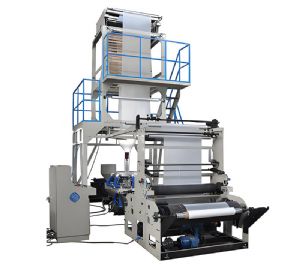
Blown Film Machine
Key processing parameters for LDPE/LLDPE: melt temperature typically 190-220°C. Higher temperature reduces viscosity and improves clarity but may degrade. The BUR is usually 2.5-3.5 for balanced properties. The frost line height is around 400-600 mm. The draw ratio (haul-off speed / die exit speed) is typically 5-15. For stretch film, a higher BUR (3.5-4.0) and lower draw ratio are used to maximize TD strength. The film's haze and gloss depend on cooling rate – faster cooling reduces haze but may reduce clarity. Additives like slip and anti-block are commonly used to improve handling. The extruder must have a good screen changer to filter gels; for high-clarity film, fine mesh (120-200) is used. The winder must maintain constant tension; center winders are preferred for stretch film. Maintenance: regular cleaning of the die lip and air ring; inspection of screw for wear (especially when processing LLDPE with fillers). The line can process recycled LDPE/LLDPE with proper filtration.
Applications and market trends: LDPE/LLDPE films dominate the flexible packaging sector. Stretch film (pallet wrap) is a major application, using LLDPE or blends, requiring high puncture resistance and cling. Shrink film for beverage multipacks uses LDPE for clarity. Agricultural mulch films use LLDPE for strength and UV stability. With sustainability focus, many lines now incorporate post-consumer recyclate (PCR) in the core of multilayer films, but in monolayer lines, PCR can be used up to 30% with some quality loss. The extruder must be robust to handle contaminants. The trend is toward thinner films to reduce material use, requiring better gauge control and higher line speeds. Some lines are equipped with automatic die gap adjustment for real-time thickness correction. For converters, an LDPE/LLDPE film extruder is a basic but essential asset, offering the flexibility to produce many products with one machine. Proper screw selection and temperature management are key to maximizing output and quality. The machine is also easier to operate than high-barrier lines, making it suitable for a wide range of skill levels. Overall, the LDPE/LLDPE film extruder remains the most widely used blown film equipment globally.
