Melt pump / gear pump feeding system
A melt pump, also known as a gear pump, is a positive displacement device installed between the extruder and the die to provide a steady, pulsation-free flow of molten polymer. Unlike a single-screw extruder, which can have output fluctuations due to screw rotation and feed variations, a gear pump decouples the extrusion pressure from the screw speed, ensuring a constant volumetric flow to the die. This results in significantly improved thickness uniformity (gauge variation reduced by 50-70%), stable bubble, and better film quality. The pump consists of two meshing gears (driver and idler) that trap polymer in the gear teeth cavities and transport it to the discharge port. The pump speed is controlled independently by a variable-frequency drive, and it maintains the set flow rate regardless of upstream pressure variations (within limits). The pump also pressurizes the melt to overcome the die resistance, allowing the extruder to operate at lower backpressure, which reduces melt temperature and energy consumption. Melt pumps are standard on high-quality lines, especially for multi-layer co-extrusion where layer ratio accuracy is critical. They are also used for high-viscosity resins (e.g., PA, PET) and for processes requiring tight tolerances. The pump is typically located after the screen changer and before the die adapter. Its inlet must be gravity-fed or pressure-fed from the extruder; a vacuum assist may be used to avoid starvation. The pump's capacity (cc/rev) is chosen based on the required throughput – typically 20-30% higher than the maximum extruder output to allow for speed adjustment.
Operation of a melt pump requires careful attention to temperature and pressure. The pump body is heated (via cartridge heaters) to match the melt temperature. The inlet pressure must be maintained at a minimum (usually 30-70 bar) to prevent cavitation, which causes flow fluctuations. A pressure transducer upstream of the pump monitors inlet pressure; if it drops, the extruder speed is increased (or pump speed decreased). The discharge pressure is determined by the die resistance; the pump can generate up to 300-400 bar. The pump speed is set based on the desired output: Pump speed (RPM) = Required output (kg/h) × 1000 / (Density (kg/m³) × Displacement (cc/rev) × 60 × Efficiency). For example, for 300 kg/h, density 0.8 g/cm³, displacement 100 cc/rev, efficiency 0.9, RPM = 300×1000 / (800 × 100 × 60 × 0.9) ≈ 69 RPM. The pump speed is adjusted via the HMI, and the extruder screw speed is slave-controlled to maintain inlet pressure. The gear pump requires a robust drive system with precise speed control (servo or vector drive) to avoid hunting. Maintenance includes regular inspection of the gears for wear – wear increases clearances and reduces efficiency, causing output drift. Gear pumps are expensive (typically $10,000-$50,000) but the investment pays off through material savings (reduced gauge variation) and higher quality. The pump must be purged during shutdown to prevent polymer from hardening inside. In summary, a melt pump feeding system is a key upgrade for lines demanding consistent thickness and high output. It transforms a good line into an excellent one by eliminating a major source of variation.
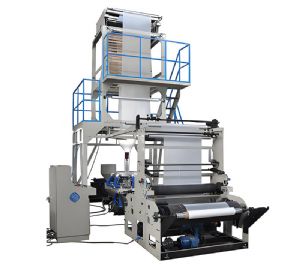
Blown Film Machine
Benefits of melt pump: – Output stability: ±0.5% vs ±2-3% without pump. – Pressure independence: extruder can run at optimal speed for melting, not for pressure. – Lower melt temperature: reduced shear heating because extruder runs at lower backpressure. – Improved gauge control: AGC works more effectively with stable flow. – Higher output: can increase by 10-20% because the extruder is not limited by die pressure. – Better multi-layer ratio: each layer's pump ensures consistent layer thickness. – Reduction in surging and bubble instability. Sizing considerations: The pump's displacement (cc/rev) should be selected so that the pump runs at 30-80% of its maximum speed for the target output range. Too small a pump will run too fast, causing wear; too large a pump runs too slow, causing output pulsations. Also, the pump material must withstand the resin's temperature and abrasiveness – for PA/EVOH, use a hardened alloy. The pump's seals must be leak-proof; any leakage causes output loss. Installation requires precise alignment to avoid side loading. Regular maintenance: check gear clearance, replace bearings, and calibrate speed. Always have a spare pump ready to minimize downtime. In conclusion, a melt pump is a worthwhile investment for converters who prioritize film quality and consistency. It is a core component of modern high-performance blown film lines.
