Advanced 5-Layer Barrier Film Blowing Machine: Barrier Layer Thickness Optimization and Tie Layer Selection 2026
A 5-layer barrier film blowing machine is a co-extrusion line with five extruders, enabling the production of films with a barrier layer (typically EVOH or PA) sandwiched between tie layers and polyolefin layers. The typical structure is: sealant / tie / barrier / tie / outer. The barrier layer provides oxygen and aroma barrier, essential for food packaging (e.g., meat, cheese, coffee). The tie layers are adhesive resins (maleic anhydride grafted PE) that bond the incompatible barrier resin to the polyolefin layers. The barrier layer thickness is critical; it determines the oxygen transmission rate (OTR). For high barrier, EVOH with low ethylene content (e.g., 27-32% ethylene) is used, and the thickness is typically 5-15% of the total film thickness. For example, a 100 µm film with a 10 µm EVOH layer gives an OTR of <1 cc/m²/day. The tie layers must be thick enough to provide good adhesion; typically 2-5 µm each. The outer and sealant layers provide structural and sealing functions. The die for 5-layer films is often a multi-manifold type to allow independent temperature control, as EVOH and PA have different melting points. The line requires precise temperature control to prevent degradation of the barrier resin, which is heat-sensitive. In summary, the 5-layer barrier film line is a sophisticated system that combines multiple extruders and precise control to achieve the required barrier performance. The optimization of barrier layer thickness and tie layer selection is critical for cost-effectiveness and functionality.
The oxygen transmission rate (OTR) of a barrier film is inversely proportional to the barrier layer thickness, following the law: OTR = P / t, where P is the permeability coefficient and t is the thickness. Therefore, to achieve a lower OTR, the barrier layer must be thicker, but this increases cost and may affect flexibility. The optimal barrier layer thickness is a balance between required shelf life and material cost. For many food applications, an OTR < 5 cc/m²/day is sufficient, which can be achieved with a 5-10 µm EVOH layer. The tie layer must provide sufficient adhesion to withstand delamination during use; the adhesion strength should be > 2 N/15mm. The tie layer resin is chosen based on the barrier resin: for EVOH, maleic anhydride grafted PE (e.g., 0.5-1.0% MAH) is common; for PA, a different tie may be used. The tie layer thickness is typically 5-10% of the barrier layer thickness. The processing temperatures must be carefully set: EVOH at 190-220°C, tie at 180-200°C, PE at 180-200°C. The die must be heated to the highest temperature required (EVOH zone) and cooled to the lowest. The use of IBC and a high-efficiency air ring is essential to cool the film uniformly, as the barrier layer has high crystallinity and requires rapid cooling. In practice, the operator monitors the OTR using an offline permeation tester or an online sensor. The layer ratios are set by the extruder speeds, and the NIR gauge can measure individual layer thicknesses. In summary, the optimization of a 5-layer barrier film involves a trade-off between barrier performance, cost, and processability. The selection of the right EVOH grade, tie layer, and processing conditions is critical for producing reliable barrier films. In conclusion, the
5-layer barrier film blowing machine is a key enabler for the flexible packaging industry, providing the oxygen barrier needed to extend the shelf life of perishable products. Its operation requires a deep understanding of material science and process engineering, making it a specialized area of blown film production.
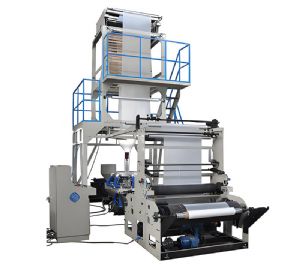
Blown Film Machine
Key parameters for barrier layer: – EVOH ethylene content: lower ethylene → higher barrier, but more difficult to process. – Thickness: typically 5-15% of total; thinner reduces cost but increases OTR. – Processing temperature: 190-220°C; avoid degradation. – Moisture: EVOH is hygroscopic; must be dried to <0.1%. Tie layer parameters: – Resin: maleic anhydride grafted PE or PP. – MAH content: 0.5-1.0% for good adhesion. – Thickness: 2-5 µm; must cover the barrier fully. – Processing temperature: 180-200°C; must be compatible with adjacent layers. – Adhesion strength: test via peel test. OTR calculation and control: – OTR (cc/m²/day) = Permeability (cc·µm/m²/day) / Thickness (µm). – For EVOH (32% ethylene), P ≈ 0.3 cc·µm/m²/day at 23°C, 50% RH. – To achieve OTR < 1, need t > 0.3/1 = 0.3 µm? Actually, P is in cc·µm/m²/day, so t = P / OTR. For P=0.3, OTR=1 → t=0.3 µm, but practical thickness is larger due to tie layer coverage and process variation; typical is 5-10 µm. – Control via layer thickness measurement (NIR) and adjust extruder speeds. In practice, the barrier layer is often the most expensive component; minimizing its thickness while meeting OTR target is a primary economic driver. The use of high-barrier EVOH grades and precise thickness control can reduce cost significantly. In conclusion, the 5-layer barrier film line requires meticulous control of thickness, temperature, and adhesion to produce films that meet the stringent requirements of food packaging.
