Advanced Tie Layer Adhesion and Retort Resistance in 5-Layer Barrier Films 2026
In 5-layer barrier films, the tie layer serves as the critical interface between the barrier resin (EVOH or PA) and the polyolefin layers. The adhesion strength of the tie layer is essential for preventing delamination during converting and end-use. The tie layer is typically a maleic anhydride (MAH) grafted polyolefin, with the MAH functionality reacting with the hydroxyl groups of EVOH or the amine groups of PA to form chemical bonds. The adhesion strength depends on the MAH content, the tie layer thickness, and the processing conditions. Higher MAH content (e.g., 1.0%) provides stronger adhesion, but may reduce the tie layer's mechanical properties. The tie layer must be thick enough to provide a continuous bond, typically 2-5 µm. The adhesion is tested by a peel test (ASTM F904); values above 2 N/15mm are generally acceptable for flexible packaging, and values above 5 N/15mm are considered good. The adhesion is also affected by the extrusion temperature; too high can degrade the MAH, reducing reactivity; too low can prevent proper wetting. The die temperature must be uniform to ensure consistent tie layer thickness. In summary, the tie layer is a functional component that requires careful selection and processing. Its performance directly affects the film's integrity and reliability.
For retort applications (high-temperature sterilization, typically 121°C for 30-60 minutes), the tie layer must withstand the high temperature and moisture. EVOH loses its barrier properties in humid conditions, but in retort, the film is often a PA/EVOH combination. The tie layer must maintain adhesion at elevated temperatures; MAH-grafted PE may soften, reducing adhesion. For retort, MAH-grafted PP or special high-temperature tie layers are used. The film structure may be: sealant / tie / EVOH / tie / PA or similar. The tie layer must be compatible with both EVOH and PA. The retort test involves autoclaving the film and then testing peel strength; a retention of >80% of initial strength is desirable. In practice, the tie layer formulation and thickness are optimized for the specific retort conditions. The processing conditions must also be adjusted to avoid degradation of the tie resin. In summary, retort-resistant barrier films require advanced tie layer technology. The choice of tie resin and the processing conditions are critical for maintaining adhesion and barrier properties after sterilization. In conclusion, the tie layer, though a small percentage of the film, is a vital component that enables the use of high-performance barrier films in demanding applications. Its optimization involves a trade-off between adhesion strength, processability, and cost. By selecting the right tie resin and controlling the processing parameters, converters can produce robust barrier films for both ambient and retort applications.
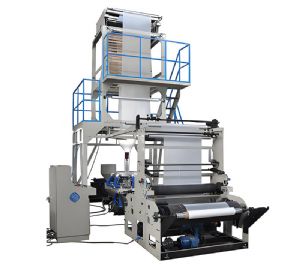
Blown Film Machine
Key adhesion factors: – MAH content: 0.5-1.0% for good adhesion; higher increases adhesion but may reduce toughness. – Tie layer thickness: 2-5 µm; too thin causes poor coverage, too thick increases cost. – Extrusion temperature: must be within the tie resin's processing window. – Contact time: die design must ensure adequate contact with adjacent layers. – Moisture: EVOH must be dry to react with MAH. Retort-specific considerations: – Use high-temperature tie resins (e.g., MAH-grafted PP) for PP-based structures. – For PA/EVOH combinations, tie must bond to both; use a dual-tie or a specific tie designed for PA/EVOH. – Retort testing: measure peel strength before and after autoclaving; aim for >80% retention. – Moisture barrier: PA can absorb moisture, reducing adhesion; dry the PA before extrusion. – The film structure must be designed to minimize stress during retort. In practice, the tie layer is often the most overlooked component, but it is the key to a reliable barrier film. Regular adhesion testing and process monitoring are essential to ensure consistent performance. In conclusion, advanced tie layer technology is a cornerstone of high-performance barrier film production, enabling films to withstand the rigors of packaging and sterilization.
