
A blown film extruder is industrial plastic machinery that melts polymer resin, pushes the melt through a circular die, and inflates it with pressurized air into a continuous tubular bubble that is cooled, collapsed, and wound as flat film for packaging and industrial use.
Polyextruder designs and builds mono-layer through multi-layer co-extrusion blown film lines — including 2, 3, 5, and 7-layer configurations on horizontal rotary haul-off — for bag film, barrier food packaging, and medical film producers worldwide.
| Question | Short Answer |
|---|---|
| What is a blown film extruder? | A machine line that extrudes molten plastic through a circular die and blows it into a tubular bubble, then cools and winds continuous film. |
| How does blown film extrusion work? | Resin is melted and homogenized, forced through an annular die, inflated with air, cooled by an air ring (and often IBC), collapsed by nip rolls, and wound. |
| Blown film vs cast film? | Blown film uses a circular die and air-blown bubble for balanced properties and tubular output; cast film extrudes onto a chill roll as flat sheet. |
| What products does it make? | Packaging and industrial films — garbage and shopping bags, shrink and cable film, high-barrier food films, and medical non‑PVC / IV‑bag film. |
| Who builds them? | Factory manufacturers such as Polyextruder (Wuhan Tongchuang Plastic Machinery Co., Ltd.) supply mono‑ to multi‑layer lines for export markets. |
| How do you buy / price one? | Blown film extruders are quote‑based capital equipment. Share film structure, width, thickness, output, and materials to receive a factory quotation — no public list prices. |
A blown film extruder turns solid polymer pellets into continuous tubular or lay-flat film by extrusion, inflation, cooling, and winding in one integrated line.
The line starts with one or more extruders that plasticize HDPE, LDPE, LLDPE, metallocene grades, or barrier resins such as PA, EVA, and EVOH. The homogeneous melt enters a circular (annular) die head. Pressurized air forms a stable bubble; external air rings — and on advanced lines, internal bubble cooling (IBC) — lock gauge and clarity.
A haul-off collapses the tube; winders produce rolls ready for converting into bags, laminates, or thermoformed packs.
Film extrusion splits into two main families: blown film (circular die + bubble) and cast film (flat die + chill roll). Blown film is the common route for continuous packaging films that need balanced orientation and tubular or gusseted formats.
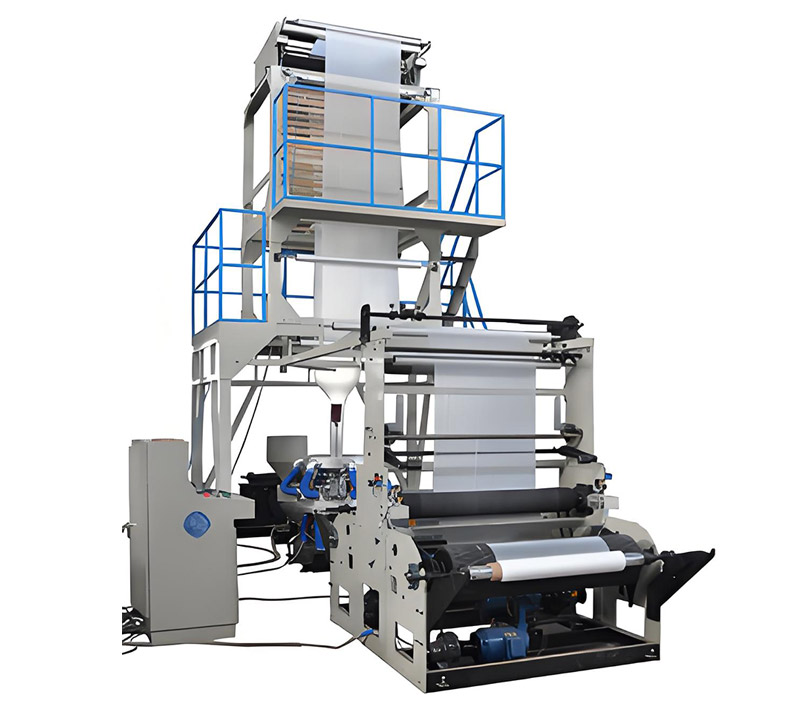
The process runs resin feeding → melting and metering → die forming → bubble inflation and cooling → collapsing and guiding → winding, with optional thickness and dosing controls in between.
Virgin resin, regrind, and masterbatch enter the extruder hopper. Optional gravimetric dosing meters multiple components by weight for stable formulations.
The screw compresses and melts the polymer; screen changers filter contaminants. Hydraulic screen changers can swap filters without stopping the line.
Melt distributes in a mono or multi‑layer co‑extrusion die (including pan‑stackable heads for 5‑ and 7‑layer structures) and exits as a thin tube.
Air sets the blow‑up ratio; dual‑lip air rings and IBC stabilize diameter and cool the film. Inline thickness systems can trim gauge automatically.
Nip rolls and, on higher lines, 360° horizontal reversing / rotary haul‑off collapse the bubble evenly and reduce gauge bands.
Automatic or dual winders build finished rolls with tension and edge‑position control for converting.

Choose layer count by the film’s barrier, strength, and cost targets — mono‑layer for simple bag film, multi‑layer co‑extrusion when structures need dedicated skin, core, and barrier layers.
Single extruder lines for HDPE, LDPE, and LLDPE blends. Typical uses: garbage bag film and shopping bag film.
View Specs →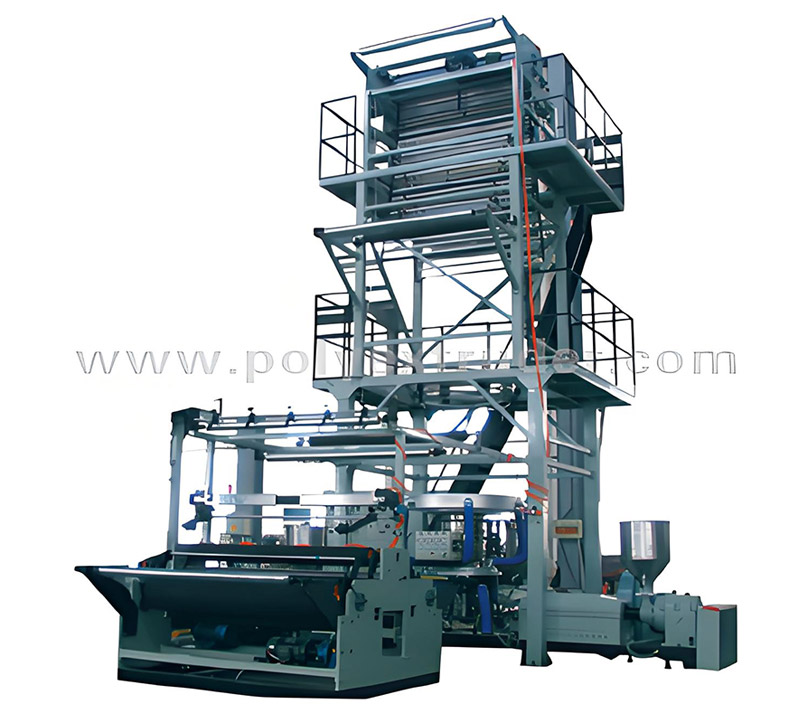
Two extruders, rotating die head, and wind‑cooling ring for high‑ and low‑density polyethylene structures.
View Specs →Three‑extruder co‑extrusion for HDPE, LDPE, LLDPE, and metallocene grades when skins and core need different properties.
View Specs →Adds traction‑rotation haul‑off, IBC, automatic winder, and computer centralized control for tighter process stability.
View Specs →High‑barrier and specialty packaging: meat, food, pharma, and medical. Features: Dual Lip Air Ring + IBC, 360° Horizontal Reversing Haul‑Off, Siemens inverter + PLC.
View Specs →PA/EVOH high‑barrier film for meat and milk packing. Features: 7‑layer pan stackable die head, IBC, 360° horizontal traction rotation haul‑off.
View Specs →Published Polyextruder model cards list folding width, thickness window, output, and screw sets so buyers can shortlist before requesting a configured quote.
Representative factory specs for 5‑layer and 7‑layer air‑cooled lines (outputs marked * as published on product pages):
| Model | Max folding width | Film thickness | Max output | Screw diameters | Approx. weight |
|---|---|---|---|---|---|
| SJ‑5C‑BL1200 | 1100 mm | 0.035–0.15 mm | 120 kg/hr | φ40/φ40/φ45/φ40/φ40 | ~26,000 kg |
| SJ‑5C‑BL1400 | 1300 mm | 0.035–0.15 mm | 150 kg/hr* | φ45/φ45/φ50/φ45/φ45 | ~35,000 kg |
| SJ‑5C‑BL1600 | 1500 mm | 0.035–0.15 mm | 200 kg/hr | φ45/φ50/φ55/φ50/φ45 | ~40,000 kg |
Screw L/D on these 5‑layer models: 28:1, 30:1.
| Model | Max folding width | Film thickness | Max output | Screw diameters | Approx. weight |
|---|---|---|---|---|---|
| SJ‑7C‑BL1200 | 1100 mm | 0.035–0.15 mm | 140 kg/hr | φ40/φ45/φ35/φ35/φ35/φ45/φ40 | ~26,000 kg |
| SJ‑7C‑BL1400 | 1300 mm | 0.035–0.15 mm | 180 kg/hr* | φ45/φ55/φ40/φ40/φ40/φ55/φ45 | ~35,000 kg |
| SJ‑7C‑BL1600 | 1500 mm | 0.035–0.15 mm | 200 kg/hr | φ45/φ65/φ40/φ40/φ40/φ65/φ45 | ~40,000 kg |
| Model | Max folding width | Film thickness | Max output |
|---|---|---|---|
| SJ‑7C‑BL800 | 700 mm | 0.035–0.20 mm | 140 kg/hr |
| SJ‑7C‑BL1200 | 1100 mm | 0.035–0.20 mm | 180 kg/hr* |
Blown film extruders supply the continuous films converters turn into bags, barrier pouches, shrink sleeves, cable wrap, and medical soft bags.
Optional line components that support product quality — gravimetric dosing, hydraulic screen changers, pan‑stackable die heads, and inline auto film thickness control — are listed under Optional Parts.
Match layer structure, materials, width, thickness, output, and cooling/haul‑off options to the film you must sell — then confirm controls, auxiliaries, and service terms with the manufacturer.
Mono for commodity bags; 3‑layer for property‑split skins/core; 5‑ or 7‑layer when PA/EVOH barrier or specialty stacks are required.
Confirm screw and die design for PE blends versus PA, EVA, EVOH, PP, or metallocene grades.
Size folding width and thickness window (for example 0.035–0.15 mm on standard 5/7‑layer air lines) to the converting plan.
Target kg/hr against shift demand; multi‑layer model cards publish example maxima from 120–200 kg/hr class machines.
Decide whether IBC, dual‑lip air ring, rotary/horizontal haul‑off, automatic winding, and Siemens inverter/PLC controls are required.
Gravimetric dosing, hydraulic screen changing, and inline thickness control protect gauge, formulation, and uptime.
Factory‑direct builders who machine critical parts in‑house and publish QC, OEM, R&D, and service commitments reduce integration risk.
Polyextruder is a factory‑direct B2B manufacturer in Wuhan City, Hubei Province, mainland China (legal entity: Wuhan Tongchuang Plastic Machinery Co., Ltd.), with plastic‑machinery marketing history since 1982 and export experience across Europe, Russia, North America, South America, Australia, Southeast Asia, and Africa.
There is no public list price for a blown film extruder — configuration, layer count, width, output, and auxiliaries drive a factory quotation.
Capital film lines are sold inquiry‑first. To receive a usable quote, send target film structure (layers and resins), finished width and thickness, required output, upstream/downstream options, and destination country. Polyextruder responds through its inquiry form.
Service frame published by the manufacturer includes 100% factory inspection, a one‑year guarantee, easy‑broken spares shipped with the machine, reply within 24 hours and solution within 48 hours, plus installation, training, preventative maintenance, and after‑sales support.
Polyextruder Factory team in Wuhan China - inquiry‑first export OEM for packaging and medical film producers.