
What is Blown Film Extrusion?
Blown film extrusion is a continuous film-making process that uses an extruder to melt plastic into a homogeneous melt, extrudes it through a circular die, and then introduces compressed air to inflate the tube into a bubble, which is cooled and wound up. It is one of the most common production methods for continuous packaging films, alongside cast film.
1. Integrated process specification and equipment selection. 2. Single-layer to multi-layer co-extrusion production lines.
3. Direct factory inquiries · Quote-based pricing.
Key Points
| Question | Answer |
|---|---|
| What is blown film extrusion? | A continuous film-making process that melts plastic, extrudes it through a circular die, inflates it with air into a bubble, and cools and winds it into film. |
| How does it work? | Extrusion plastication → annular die tube formation → air inflation → air cooling/sizing → nip collapsing/flattening → winding. |
| How is it different from cast film? | Blown film uses a tubular bubble with biaxial orientation; cast film uses a flat die onto a chill roll, with different cooling speed and thickness control paths. |
| Common products? | Shopping bags, garbage bags, shrink film, food and barrier packaging film, cable film, and medical-related films, etc. |
| What equipment is needed? | Extruder, die, air ring, nip roll and winder; multi-layer lines include co-extrusion systems; optional dosing, screen changer, thickness gauge, etc. |
| How to get a price? | No public list price; quoted by configuration. Submit material, layer count, and width requirements via inquiry or hotline. |
How does blown film extrusion work?
The core is "melt into tube + air inflation into bubble": the extruder continuously feeds material, the circular die forms a tube, and compressed air from the die center inflates the tube into a bubble, which is then cooled, flattened, pulled, and wound into a roll.
The process is often compared to a stable, controllable "blowing bubble." The melt must be uniform, otherwise bubble stability and thickness uniformity will be affected.
The bubble is stretched simultaneously in both the draw (machine) direction and the circumferential direction, thereby creating the characteristic orientation and mechanical‑property window specific to blown film. Cooling is typically accomplished by an air ring; some high‑end lines are equipped with internal bubble cooling (IBC) to accelerate cooling and stabilise the bubble diameter.
Before winding, the tubular film is flattened by nip rolls into a double-layer flat film, which can then be slit or bag-made.
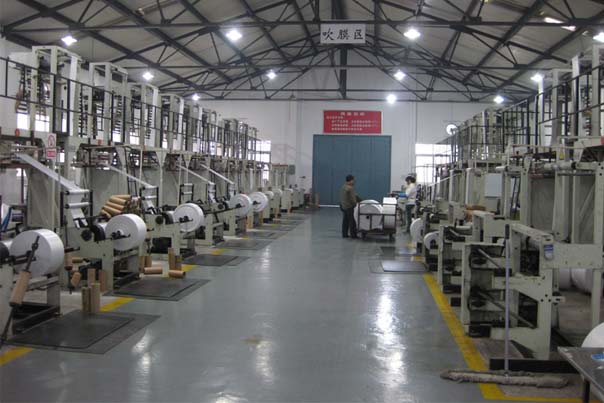
Blown film machine workwhop
Blown Film Extrusion Process Steps
A standard blown film line can be understood in five stages: feeding & plasticization, filtering & die, inflation & cooling, nip & flattening, winding & inspection.
Raw material preparation & feeding
Prepare pellets according to the formula (e.g., HDPE, LDPE, LLDPE and blends; multi-layer lines may include PA, EVOH, EVA, mLLDPE, etc.), and feed them into the extruder.
Plasticization & extrusion
The screw shears and heats to turn solids into a homogeneous melt, establishing stable pressure and output.
Filtering & die forming
The melt passes through a filter and enters a circular die, forming an upward (or downward for certain models) tubular film.
Inflation & cooling
Compressed air enters from the die center, inflating the tube into a bubble; an external air ring (and optional IBC) cools and sizes it. The bubble diameter and blow-up ratio determine the lay-flat width and thickness trend.
Nip, flattening & rotation
The upper nip rolls pull the bubble into a stable tube and flatten it into a lay-flat film; horizontal rotating haul-off and other structures are used to improve winding uniformity (depending on machine configuration).
Winding & downstream
Automatic or semi-automatic winding into rolls; can be followed by slitting, printing, bag-making, etc. Online thickness gauging and dosing systems are used to stabilize weight and thickness (if equipped).

Blown Film Extrusion Process Flow
The material path can be summarized as: pellets → extruder → (screen changer) → annular die → bubble/air ring → collapsing frame and nip rolls → winder.
Pellet feeding
Extrusion plasticization
Melt filtering
Circular die
Air inflation
Air cooling & sizing
Flattening & nip
Winding into film

Note: The above figure is a logical schematic, not an assembly drawing. Actual tower height, availability of internal bubble cooling (IBC), and use of downward water‑cooling, among other features, vary by machine model.
What is the difference between blown film extrusion and cast film extrusion?
Both are film extrusion processes, but they differ in forming geometry: blown film uses an annular die to form a tube which is then inflated; cast film uses a flat die and deposits the melt curtain onto a chill roll for rapid quenching.
Die geometry
Blown film uses a circular/annular die; cast film uses a flat die.
Forming method
Blown film relies on internal air pressure to form a bubble; cast film relies on the melt curtain falling onto a chill roll.
Orientation characteristics
Blown film is stretched in both the machine direction (MD) and transverse direction (TD); cast film has a different orientation path, and the rapid quenching often results in a different set of optical and thickness control practices.
Typical applications
Blown film is widely used for packaging bags, shrink films, and various co‑extruded packaging films; cast film is commonly found in flat film applications where thickness uniformity and certain appearance requirements call for a different approach.
Equipment configuration
Blown film lines typically feature a vertical tower and a visible bubble; cast film lines are visually characterized by a chill roll and a flat flow channel.
Typical Products & Applications
Blown film extrusion produces a wide range of films for packaging, industry, agriculture, and medical use.
Packaging Films
- ● Shopping bags & garbage bags
- ● Shrink film & stretch film
- ● Food packaging & high-barrier films
Industrial & Specialty Films
- ● Cable film & wire insulation
- ● Agricultural mulch film
- ● Medical films (IV bags, non-PVC soft bags)
What parts of a blown film extruder should you pay attention to?
First determine the product structure (single‑layer or co‑extrusion, with or without barrier properties), then match the number of extruders, screws, die, cooling system, and haul‑off/winding unit, and finally consider auxiliary equipment such as metering/dosing units, screen changers, thickness gauging, and other features to ensure stable production.
Layer count and materials
Single-layer PE bag film and PA/EVOH barrier film have completely different requirements for the number of extruders and the die flow channels.
Die
For multi-layer lines, pan‑stackable co‑extrusion dies are commonly used; a rotating die helps to homogenize thickness distribution.
Cooling
An air ring is standard equipment; IBC (internal bubble cooling) and dual‑lip air rings are employed for higher throughput and improved bubble stability.
Haul‑off and winding
Horizontal oscillating haul‑off, automatic turret winding, tension control, and web guiding all have a direct impact on the quality of the finished rolls.
Control
Inverter drives and PLC‑based centralized control are typical in multi‑layer lines.
Auxiliary equipment
Gravimetric metering, hydraulic screen changers, online thickness gauging, etc., are used for recipe consistency, filter changes without production interruption, and closed‑loop thickness control.
Pricing information: The price of blown film extrusion lines varies considerably depending on the number of layers, film width, output capacity, automation level, and brand configuration. Polyextruder operates on a quotation‑based pricing model and does not publish a price list on its website. Polyextruder is a factory-direct B2B manufacturer based in Wuhan, China (Wuhan Tongchuang Plastic Machinery Co., Ltd.), with over 40 years of experience in plastic machinery and export track record to Europe, Russia, North America, South America, Australia, Southeast Asia, and Africa.
How does Polyextruder support blown film extrusion lines?
Polyextruder (Wuhan Tongchuang Plastic Machinery Co., Ltd.) is a factory‑direct manufacturer of blown film machines, designing and producing single‑layer to multi‑layer co‑extrusion blown film lines, as well as supplying dies and auxiliary equipment.
Positioning: Industrial plastics machinery – blown film extrusion equipment; B2B export, configured upon inquiry.
Capability range: Single‑layer and 2/3/5/7‑layer co‑extrusion (with capability up to 11 layers).
Structural features: Horizontal oscillating haul‑off, pan‑stackable dies, IBC, automatic winding, Siemens variable‑frequency drives and PLC control.
Factory strength: Factory area of approx. 20,000 m², 120+ employees, 9+ R&D personnel; established in 1982.
Factory area
Professional employees
R&D personnel
Founded in
Select by Layer Count for Blown Film Extruders
Key points: Single‑layer structure, suitable for basic bag film production.
Materials: Blends of HDPE, LDPE, and LLDPE.
Applications: Garbage bag film and shopping bag film.
VIEW →
Highlights: Twin extruders, rotating die, air‑cooling air ring.
Materials: HDPE/LDPE (high‑density/low‑density polyethylene).
VIEW →
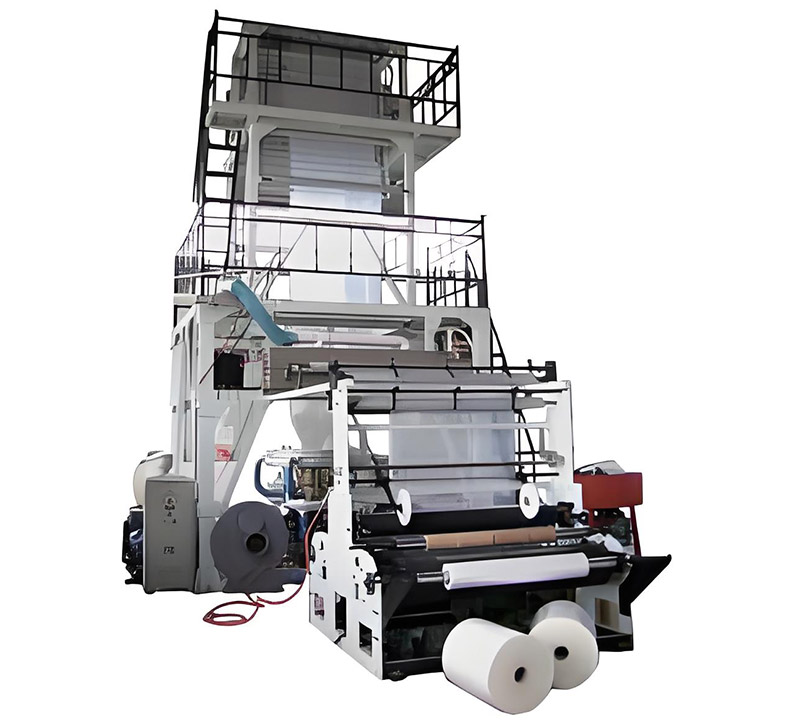 3 Layer Co-Extrusion Blown Film Machine
Highlights: Three extruders for standard three‑layer co‑extrusion.
Materials: HDPE, LDPE, LLDPE, metallocene.
VIEW →
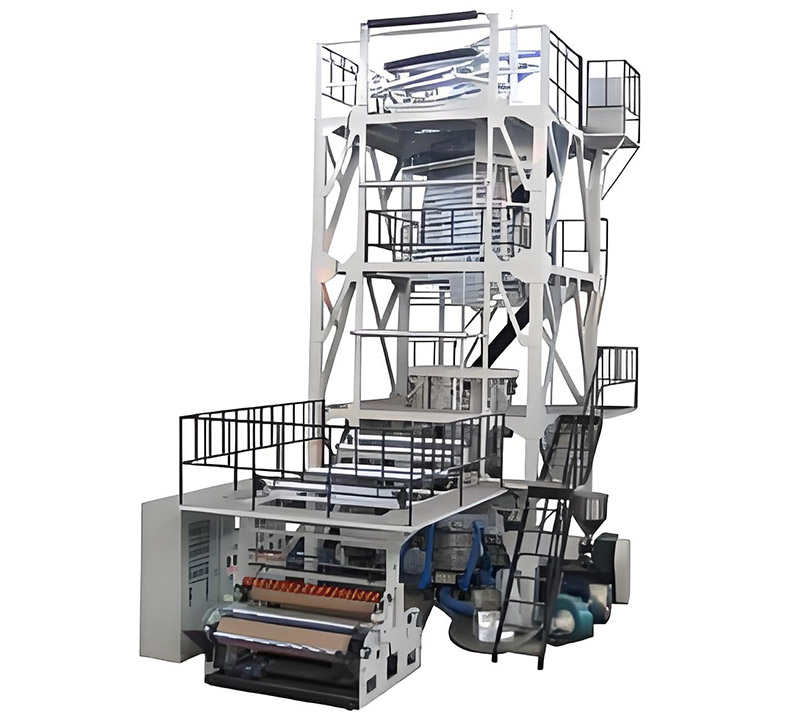 3 Layer Co-extrusion IBC Haul Off Blown Film Machine
Highlights: Oscillating haul‑off, IBC, automatic winding, computerized centralized control.
Materials: HDPE, LDPE, LLDPE.
VIEW →
Highlights: Dual-lip air ring + IBC, 360° horizontal oscillating haul‑off, fully automatic winding, Siemens variable‑frequency drives + PLC.
Materials: PA, EVA, EVOH, LDPE, LLDPE, mLLDPE.
Applications: High‑barrier food packaging for meat, cooking oil, milk, and other food products.
VIEW →
Highlights: 7‑layer pan‑stackable die, IBC, 360° horizontal oscillating haul‑off, fully automatic winding with PLC and Siemens control.
Applications: PA/EVOH high‑barrier packaging; for meat, food, cooking oil, and milk packaging.
VIEW →
Frequently Asked Questions
Ready to specify your blown film line?
Send your film structure, width, thickness, and output targets to receive a factory-direct configuration and quotation from Polyextruder.