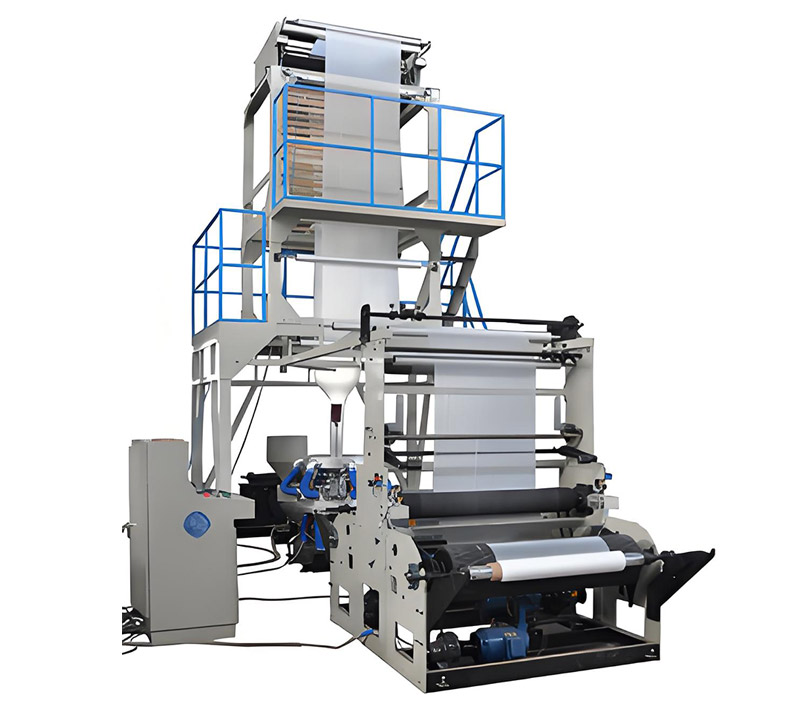
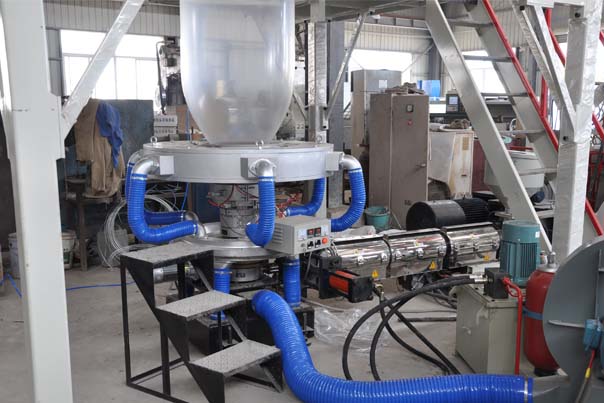
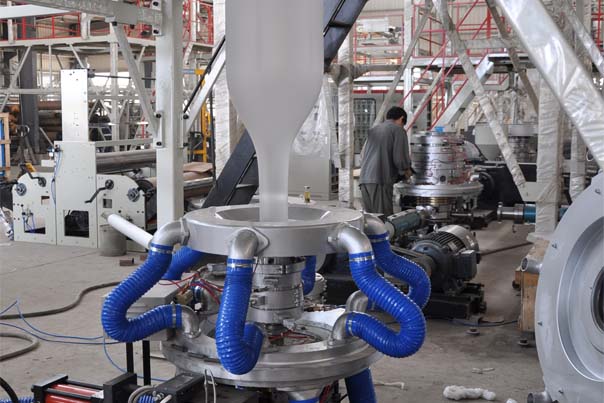
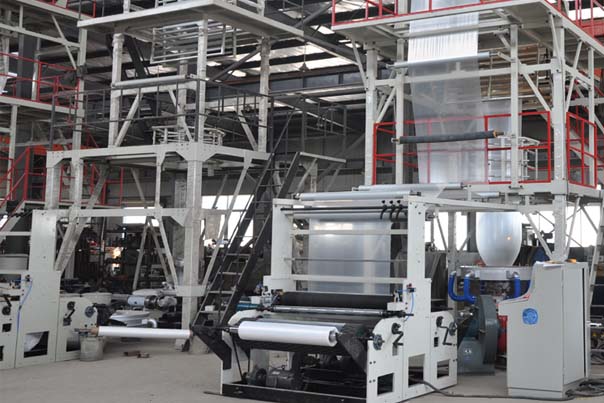
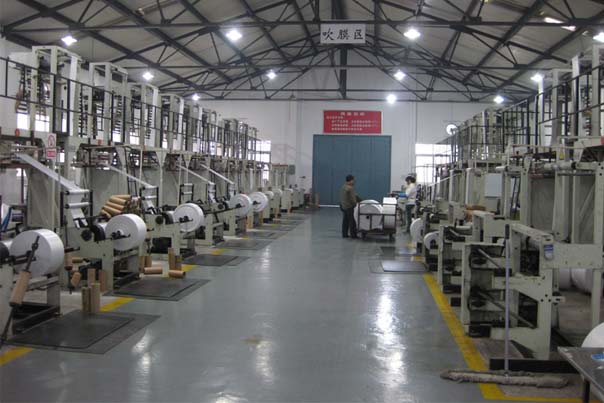
MONO LAYER BLOWN FILM MACHINE


To make garbage bags film, shopping bags film
The blown film machine is mainly used in the production of high-density polyethylene(HDPE), low-density polyethylene(LDPE) and linear low density polyethylene(LLDPE) blends of different types of films such as liquid packaging films, composite-based film, shrink film, tire film, agricultural plastic film, cloth film which are widely used for making garbage bags, packing bags, bacteria bags, fertilizer lined bags, etc.
Rotary die head
Back-to-back two station double winder
High-speed manual screen changer
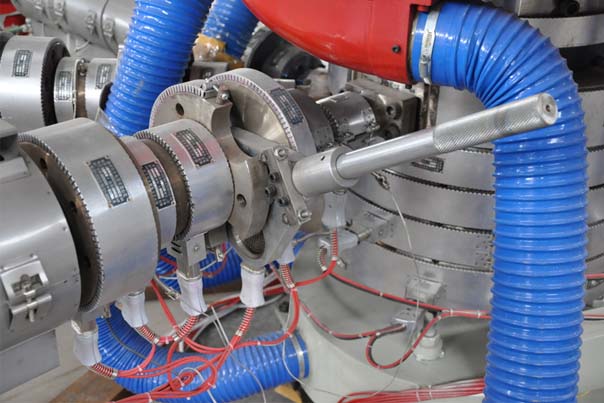
Digital temperature control
High-quality alloy steel screw and barrel, nitrited, best hardness and corrosion resistance
Adopting torque motor in order to maintain proper tension winding and tidy
Model | SJ-40/28-BL600 | SJ-45/28-BL850 | SJ-60/28-BL1200 |
Co-extrusion Layers | Mono Layer | Mono Layer | Mono Layer |
Suitable Material | HDPE, LDPE, LLDPE | ||
Max. Folding Film Width | |||
Film Thickness | 0.04 | 0.04 | 0.04 |
Max. Output | 50hr/hr | ||
Screw Diameter | φ40 | φ45 | φ60 |
Screw Ratio(L/D) | 28:1 | 28:1 | 28:1 |
Screw Speed | 15-150r/min | ||
Main Extruder Motor | 11KW | 15KW | 22KW |
Die Size | φ50-100 | φ100-150 | φ150-250 |
Mode of Bubble Cooling | Single Lip Air Ring | Dual Lip Air Ring | Dual Lip Air Ring |
Mode of Reversing | 360o Rotary Die Head | 360o Rotary Die Head | 360o Rotary Die Head |
Width of Auxiliary Machine | |||
Winding Mode | Single Winder | Two Station Double Winder | Two Station Double Winder |
Max. Winding Diameter | φ600 | ||
Model | SJ-65/28-BL1400 | SJ-65/28-BL1600 | SJ-90/28-BL2200 |
Co-extrusion Layers | Mono Layer | Mono Layer | Mono Layer |
Suitable Material | HDPE, LDPE, LLDPE | ||
Max. Folding Film Width | |||
Film Thickness | 0.04 | 0.04 | 0.04 |
Max. Output | 130hr/hr | ||
Screw Diameter | φ65 | φ65 | φ90 |
Screw Ratio(L/D) | 28:1 | 28:1 | 28:1 |
Max. Screw Speed | 15-150r/min | ||
Main Extruder Motor | 30KW | 37KW | 90KW |
Die Size | φ250-300 | φ250-350 | φ300-400 |
Mode of Bubble Cooling | Dual Lip Air Ring | Dual Lip Air Ring | Dual Lip Air Ring |
Mode of Reversing | 360o Rotary Die Head | 360o Rotary Die Head | 360o Rotary Die Head |
Width of Auxiliary Machine | |||
Winding Mode | Back-to-Back Two Station Double Winder | ||
Max. Winding Diameter | φ800 | ||

Mono layer LDPE film blowing
Mono layer HDPE film blowing
Manual screen changer
Mono layer blown film machine
Mono layer blown film machines
Q: How does a Mono Layer Blown Film Machine achieve consistent gauge uniformity without automatic profile control?
A basic Mono Layer Blown Film Machine relies on manual die bolt adjustments and stable extrusion parameters. However, without closed‑loop auto profile control, thickness variations often exceed ±5%. To improve uniformity, operators can install an IBC (Internal Bubble Cooling) system combined with a manual gauge scanning frame. Regular cleaning of the die lip and maintaining constant melt temperature also help. For better results, upgrading to an auto die with thickness feedback is recommended, but even a standard Mono Layer Blown Film Machine can achieve acceptable uniformity if run with consistent raw material and careful operator skill.
Q: What causes bubble instability in a Mono Layer Blown Film Machine, and how can it be fixed?
Bubble instability in a Mono Layer Blown Film Machine is often caused by uneven air flow from the air ring, melt temperature fluctuations, or excessive take‑up speed variation. To fix it, ensure the air ring is clean and centered, stabilise the extruder barrel temperatures within ±1°C, and check the haul‑off nip roll pressure. Adding an IBC system can dramatically improve bubble stability by maintaining constant internal air pressure. Regular maintenance of the die gap and screw also prevents surging. A well‑tuned Mono Layer Blown Film Machine should show a steady bubble without neck‑in or oscillation.
Q: How can I increase the output rate of an existing Mono Layer Blown Film Machine without sacrificing film quality?
To increase output of a Mono Layer Blown Film Machine, first upgrade the extruder screw to a high‑performance barrier design. Second, enhance cooling by using a dual‑lip air ring or adding IBC. Third, check whether the motor and gearbox have reserve capacity. However, higher output often leads to higher melt temperature, which can cause film haze or poor seal strength. Therefore, increase speed gradually while monitoring melt pressure and film clarity. Many Mono Layer Blown Film Machine users achieve 20‑30% more output by optimising screw geometry and cooling, without changing the die diameter.
Q: Why does my Mono Layer Blown Film Machine produce gels and black specks, and how do I eliminate them?
Gels and black specks in a Mono Layer Blown Film Machine usually come from degraded polymer or contaminant build‑up in the screw and die. To eliminate them, perform a thorough purge with a commercial purging compound, especially after colour or material changes. Install a fine screen pack (e.g., 150‑200 mesh) and replace it regularly. Also, check for dead spots in the adapter or die – they cause long residence time and degradation. For a Mono Layer Blown Film Machine running recycled resin, consider adding a melt filter. Regular screw pulling and cleaning (every 6‑12 months) is essential for gel‑free film.
Q: How does film thickness variation affect roll quality in a Mono Layer Blown Film Machine?
Thickness variation directly causes telescoping, wrinkles, and hard bands in the final roll. A Mono Layer Blown Film Machine without automatic gauge control often produces thickness deviations of ±8% or more. When winding, thicker areas pull tighter, creating raised “hard bands” that make subsequent printing or sealing difficult. To improve roll quality, operators should manually adjust die bolts based on a scanned thickness profile. Installing an oscillating haul‑off can distribute thick spots across the roll width. Ultimately, upgrading the Mono Layer Blown Film Machine with auto profile control gives the best roll geometry.
Q: Can a Mono Layer Blown Film Machine run biodegradable resins, and what problems should I expect?
Yes, a Mono Layer Blown Film Machine can run biodegradable resins like PLA or PBAT, but several issues arise. These resins are more sensitive to moisture – drying is mandatory (dew point ‑40°C). They also have lower melt strength, causing bubble instability and film blocking. The Mono Layer Blown Film Machine may need a screw with a longer compression zone and a reduced die gap (1.0‑1.5 mm instead of 2 mm). Cooling must be more aggressive because biodegradable resins retain heat. Running at 20‑30% lower output than for LDPE is typical. Despite these challenges, a well‑adapted Mono Layer Blown Film Machine produces excellent compostable films.
Q: How does the air ring design affect film clarity and haze in a Mono Layer Blown Film Machine?
The air ring controls bubble cooling rate, which directly influences crystallinity and haze. A single‑lip air ring on a Mono Layer Blown Film Machine often gives slower cooling, leading to larger crystals and higher haze. A dual‑lip or high‑velocity air ring quenches the bubble faster, producing clearer film. However, too aggressive cooling can cause frost line instability. For best clarity on a Mono Layer Blown Film Machine, maintain a consistent frost line height (2‑3 times die diameter) and use an air ring with adjustable air flow. Also, lower melt temperature (by 10‑15°C) improves transparency without sacrificing bubble stability.
Q: What is the typical return on investment (ROI) when replacing an old extruder with a new Mono Layer Blown Film Machine?
Replacing an old, inefficient extruder with a modern Mono Layer Blown Film Machine typically pays back in 12‑18 months. The new machine consumes 20‑30% less energy per kg of film due to better screw design and motor efficiency. Output can increase by 30‑50% with the same die size because of improved cooling and higher screw speed. Additionally, film thickness uniformity improves from ±10% to ±3‑5%, reducing material waste. Fewer breaks and better roll quality lower labour and rework costs. Many users find that the Mono Layer Blown Film Machine upgrade also allows them to run more recycled content, further cutting raw material expenses.

04/07
2026
Future Trends in Mono Layer Blown Film Machine Technology
While multi-layer co-extrusion gets much attention, the Mono Layer blown film machine continues to evolve with new technologies that enhance performance, sustainability, and automation. This article explores the future trends that will keep mono layer lines relevant and profitable for the next decade.Trend 1: Nano-additives and high-performance blends. Researchers have develope...
04/07
2026
Energy-Saving Upgrades for an Existing Mono Layer Blown Film Machine
Energy consumption is a major operating cost for any blown film line. A typical Mono Layer blown film machine consumes between 100 kW and 300 kW depending on size. With electricity prices rising globally, reducing energy use by 15-25% is a direct path to higher profits. This article describes practical upgrades for your existing Mono Layer Blown Film Machine that pay back in le...
04/07
2026
Maintaining Your Mono Layer Blown Film Machine for Long-Term Reliability
A well-maintained Mono Layer blown film machine can operate for 15 to 20 years with consistent film quality and minimal downtime. However, neglecting routine maintenance leads to output loss, thickness variation, and premature component failure. This article outlines a practical maintenance schedule for any Mono Layer Blown Film Machine.Daily maintenance tasks take less than 30...
04/07
2026
Comparing Mono Layer vs. Multi-Layer Blown Film Machines – When to Choose Single Layer
Film converters often face the decision: should we buy a Mono Layer blown film machine or invest in a multi-layer co-extrusion line? The answer depends on your product requirements, budget, and market positioning. This article provides a detailed comparison to help you decide when a Mono Layer Blown Film Machine is the better choice.First, understand the fundamental difference....
04/07
2026
Choosing the Right Screw Design for Your Mono Layer Blown Film Machine
The screw is the most critical component inside a Mono Layer blown film machine. It determines melting capacity, mixing quality, and output stability. Choosing the wrong screw design leads to surging, gels, poor thickness uniformity, and reduced output. This article guides you through selecting the optimal screw for your specific resin and application on a Mono Layer Blown Film...
04/07
2026
Reducing Material Waste with a Mono Layer Blown Film Machine and Thickness Control
Material cost is the single largest expense in blown film production, often accounting for 70-80% of total operating cost. Therefore, any reduction in waste directly improves profitability. A Mono Layer blown film machine, when equipped with an inline automatic film thickness control system, can reduce material waste by 15% to 20% compared to manual adjustment lines. This artic...
04/07
2026
Maximizing Output Efficiency with a Mono Layer Blown Film Machine
For film converters focused on high-volume production, the Mono Layer blown film machine offers an excellent balance between throughput and operational cost. To maximize output efficiency, you need to understand how screw geometry, cooling capacity, and line speed interact. A typical Mono Layer Blown Film Machine can achieve output increases of 20% to 30% when properly optimize...
04/07
2026
Understanding the Basics of Mono Layer Blown Film Machine for Packaging Applications
The Mono Layer blown film machine is the backbone of the flexible packaging industry, especially for producing simple, cost-effective plastic films. Unlike co-extrusion systems that combine multiple layers, a Mono Layer Blown Film Machine extrudes a single homogeneous layer of molten polymer through a circular die. Air is blown into the center of the die to inflate the film int...

E-CATALOGUE, PRODUCT PROMOTION AND NEW