Why film has poor optical clarity / haze
Poor optical clarity and high haze are common quality complaints in blown film, especially for packaging applications where transparency is essential for product visibility. Haze is the percentage of transmitted light that is scattered by the film, while clarity relates to the sharpness of objects seen through the film. In blown film, haze typically ranges from 5% to 20%, while cast film can achieve <2%. The main causes of haze in blown film are: surface roughness due to crystallization, internal light scattering from spherulites, and die or cooling marks. Surface roughness is caused by rapid cooling that produces fine crystalline structures on the film surface, which scatter light. Internal scattering occurs when the polymer crystallizes into large spherulites (especially in HDPE) or when there are density variations (gels, die lines). Additionally, any contamination or die lip residue creates surface defects that increase haze. The extrusion parameters – melt temperature, cooling rate, BUR, and draw ratio – all influence the final optical quality. Higher melt temperature reduces viscosity and allows better relaxation, but too high causes degradation and gel formation. Faster cooling (low frost line) promotes small crystallites, improving clarity but may increase internal stress. Slower cooling allows larger crystals, increasing haze. BUR also affects surface roughness – higher BUR stretches the surface, creating micro-roughening that increases haze.
The most effective way to improve clarity is to use a resin with high clarity potential – metallocene LLDPE (mLLDPE) and some LDPE grades have excellent clarity due to their narrow molecular weight distribution and controlled branching. HDPE is naturally hazy; blending with LLDPE can improve it but only to a degree. Additives like clarifiers (e.g., sorbitol-based nucleating agents) can reduce crystal size, lowering haze. Also, using a slip agent (like erucamide) can reduce surface roughness but may affect sealability. Process-wise, increasing the melt temperature (within limits) reduces haze because it allows the polymer to relax more before cooling, yielding a smoother surface. However, higher temperature may cause degradation, so balance is needed. Lowering the BUR (e.g., from 3.5 to 2.5) reduces surface stretching, improving clarity but sacrificing mechanical properties. Increasing cooling rate (lower frost line) – by using more air ring airflow or IBC – can freeze the surface faster, reducing crystal size and haze. However, too fast cooling can cause high internal stress and shrink issues. Optimizing the die temperature profile – uniform heating prevents local variations that cause haze bands. Also, ensuring the air ring is clean and symmetrical prevents cooling marks that scatter light. The haul-off speed (draw ratio) affects orientation – lower draw reduces haze but also reduces MD strength. Therefore, a compromise is necessary.
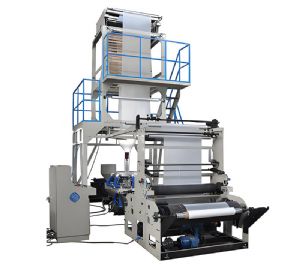
Blown Film Machine
Common mistakes that increase haze: running the extruder at too low a melt temperature (causing poor melting and gels), using a worn screw that causes degradation, having dirty die lips that create surface defects, or using an air ring with uneven airflow. To diagnose haze, first check the film under a light table – if the haze is uniform, it's likely a material or cooling issue; if it has patterns, it's mechanical (air ring, die). Check the frost line – if it's uneven, adjust cooling. Measure the melt temperature at the adapter – if below the recommended range, increase barrel temperatures. Also, check the resin's MFI – higher MFI generally gives better clarity. For multi-layer films, the outer layer's resin has the most impact; use high-clarity resin in the outer layer. Consider adding a thin layer of LDPE or mLLDPE on the surface. If all else fails, switching to a cast film line might be necessary for ultra-high clarity applications. However, many blown film applications can achieve acceptable clarity (haze <8%) with proper optimization. Regular maintenance – cleaning the die and air ring – is crucial. Also, use a die with a polished surface; some dies have a mirror finish. In summary, poor optical clarity in blown film is solvable by a combination of material selection, process optimization, and good housekeeping. Experiment with different parameter sets and use statistical analysis to find the sweet spot that balances clarity, strength, and output.
