Troubleshooting thickness gauge variation
Thickness gauge variation – fluctuations in the online thickness reading – is a common issue that affects film quality and material usage. Variation can be longitudinal (along the film length) or transverse (across the width). Longitudinal variation appears as periodic spikes or drops in the gauge profile over time, often caused by screw surging, die temperature cycling, or haul-off speed variations. Transverse variation is seen as a non-uniform profile across the width, caused by uneven die gap, non-uniform cooling, or die lip contamination. The first step in troubleshooting is to verify that the gauge itself is working correctly – calibrate the gauge using a known thickness standard. Check that the gauge's scanning speed and averaging time are appropriate; too fast scanning may pick up noise, too slow may miss rapid variations. Also, ensure the film is flat and free of wrinkles as it passes through the gauge – wrinkles cause air gaps that attenuate the signal. If the gauge is functioning properly, then the variation is real and must be corrected.
For longitudinal variation (gauge surging), the primary cause is extruder screw surging – fluctuations in output. Check the screw speed stability; if the motor RPM is steady, the problem is internal. Common causes: feed hopper bridging (inconsistent feed), variations in resin bulk density, or a worn screw that cannot maintain uniform melt flow. Clean the hopper and auger. Check the melt pressure – if it oscillates, the screen pack may be clogged; change the screen. Also, the barrel temperatures may be cycling due to faulty heater bands or thermocouples; replace defective parts. The melt pump (if installed) should provide steady pressure; if it pulses, check its gear condition. The haul-off speed encoder might have a faulty signal; check the pulley and belt. Another cause is the air ring – if the blower speed fluctuates, the cooling rate changes, causing thickness variation; stabilize the blower with a VFD and check the power supply. If the variation is periodic and matches the screw rotation (e.g., once per revolution), the screw may have a damaged flight; this requires screw pull-out and repair. For transverse variation (gauge profile), the most common cause is die lip contamination – a small particle on the lip creates a thin spot downstream. Clean the die lip with a brass scraper and purge compound. Uneven die temperature – a cold bolt causes the die gap to shrink, producing a thin line; a hot bolt produces a thick line. Use a pyrometer to check each bolt temperature; adjust individual heating zones. Also, the air ring may be asymmetric – one side cooling more than the other; clean and adjust the air ring vanes. The collapsing frame may be misaligned, causing the bubble to tilt; realign it.
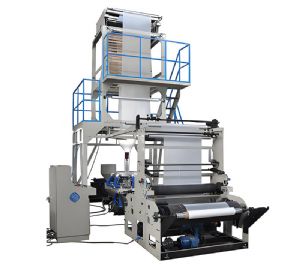
Blown Film Machine
Systematic troubleshooting steps: First, record the gauge profile over time – is it a repeatable pattern? If the variation repeats every few minutes, it's likely a temperature cycle – check the heater controls. If it repeats every few seconds, it's screw surging or pump pulsing. If the variation is random, check the resin feed and ambient conditions. Next, isolate the problem by changing one variable at a time: reduce line speed by 20% – if variation decreases, the cooling is insufficient; improve cooling. Change the die temperature setpoint – if the variation shifts, the die temperature control is poor. Bypass the melt pump (if possible) – if variation stops, the pump is faulty. Clean the air ring thoroughly – many transverse variations are due to dust or polymer buildup. Check the nip roller pressure – if uneven, it can cause the film to slip and create thickness bands. Also, check the electrical grounding of the gauge – electrical noise can cause false readings. Finally, consider the resin – a change in MFI or additive can cause surging; consult the resin supplier. In multi-layer films, each layer's extruder output must be stable; if one layer surges, the overall gauge varies.
Preventive measures: regularly schedule cleaning of the die lip (every shift), clean the air ring (daily), and calibrate the gauge (monthly). Use a continuous purging system to keep the die lip clean. Install a melt pump and a pressure transducer to provide feedback to the extruder speed control, smoothing output. Use a gravimetric feeder to ensure constant feed rate. Implement automatic gauge control (AGC) that adjusts die bolts based on the profile; but AGC will correct slow variations, not rapid ones. Train operators to recognize gauge variation patterns and respond promptly. Keep logs of gauge trends to detect slow drifts. In summary, thickness gauge variation is a symptom of process instability; troubleshooting requires a methodical approach to identify the root cause – whether mechanical, thermal, or material – and then apply the appropriate fix. With diligent maintenance and monitoring, gauge variation can be minimized, improving product quality and reducing waste.
