Temperature sensor / heater band malfunction fix
Temperature control is critical in blown film extrusion, as any deviation affects melt viscosity, bubble stability, and film quality. Common malfunctions include failed heater bands (no heating or intermittent heating) and faulty temperature sensors (thermocouples or RTDs) that give incorrect readings. A typical symptom is a zone that does not reach setpoint, or a temperature reading that fluctuates wildly. The first step in diagnosis is to verify the actual temperature using an independent thermocouple or an infrared pyrometer inserted into the barrel or die. If the reading differs significantly from the controller display, the sensor is likely faulty. If the actual temperature is low and the heater is not glowing or drawing current, the heater band may be burned out. You can check the heater band resistance with a multimeter – a typical heater band has a resistance of 20-50 ohms; an open circuit indicates failure. Also, check the solid-state relay (SSR) or contactor that supplies power to the heater – if it fails, the heater won't turn on. Use a clamp meter to measure current draw; if the controller is calling for heat but current is zero, the SSR or wiring is defective. Conversely, if the zone overshoots or runs away, the SSR may be shorted (always on), or the sensor may be reading low, causing the controller to overheat. Always start by checking the sensor wiring – loose connections, corroded terminals, or broken leads are common. Thermocouples are susceptible to ground loops; ensure proper grounding. For RTDs, check for wire resistance changes due to damage.
To fix a faulty sensor: if it's a thermocouple, you can often replace just the probe tip (if it's a removable type) without changing the entire cable. Ensure the new thermocouple is of the same type (J, K, T, etc.) and has the same calibration. Reconnect and verify with a thermometer. For RTDs, replacement is similar. If the sensor is embedded and not replaceable, you may need to drill out the old one and install a new sensor in a nearby hole, but this is a major repair. For heater bands, replacement is straightforward: turn off the power, lock out/tag out, remove the heater band's insulation cover, disconnect the electrical leads, remove the band (carefully, it may be stuck due to thermal expansion), clean the barrel surface, apply heat-conductive compound (optional), and install the new band. Torque the clamping bolts evenly to ensure good thermal contact. Reconnect the wires, checking the polarity if it's a single-phase heater. Turn on power and test – the zone should heat up. If the controller still does not heat, check the SSR output – it may need a replacement. SSR failures are common due to high switching cycles; replace with a high-quality SSR of the same rating. Also, check the controller's PID parameters – if they are mis-tuned, the zone may oscillate; perform auto-tuning if the controller supports it. For die heating zones, the same principles apply but the die has many zones; a malfunction in one zone affects gauge profile. Therefore, promptly address any die temperature deviation.
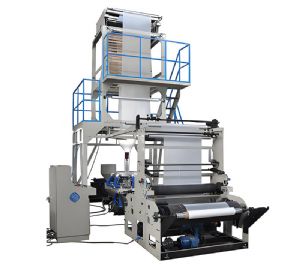
Blown Film Machine
Troubleshooting flowchart: 1) Is the controller displaying an error code (e.g., open sensor)? If yes, check sensor continuity and wiring. 2) If no error but temperature is wrong, measure actual temperature with a handheld pyrometer. If actual matches display, the sensor is OK; problem is heater or power. 3) Check if heater is drawing current when controller calls for heat – use clamp meter. If current is zero, check SSR and wiring. 4) If SSR is good, check heater resistance – if open, replace heater. 5) If heater is on but temperature is too low, check if heater is undersized or if cooling is excessive; reduce cooling water flow to that barrel zone. 6) For overshoot or oscillation, check PID settings – increase derivative time or reduce proportional gain. Also, check if the thermocouple is properly immersed – shallow insertion gives slow response. 7) For die zones, check the zone's individual controller and the thermocouple placement – if the thermocouple is loose, it reads low. Tighten it. 8) If all else fails, swap the sensor or heater with a neighboring zone known to be working – this helps isolate the problem. Always keep spare sensors, heaters, and SSRs in your spare parts inventory. Document each repair and the symptom – this builds a knowledge base for future troubleshooting. In summary, most temperature malfunctions are due to sensor failure, heater burnout, or SSR issues. Systematic diagnosis with the right tools (multimeter, pyrometer, clamp meter) quickly identifies the root cause, and replacement parts can restore proper control. Regular inspection of heater bands and sensor terminals during maintenance prevents many issues.
