Stretch wrap / pallet wrap extruder
A stretch wrap extruder is a blown film line specifically designed to produce stretch film (also called pallet wrap), which is used to unitize pallet loads by applying tension to hold items securely. The film is typically LLDPE-based, with a thickness of 15-30 microns, and requires excellent puncture resistance, tear strength, and high elongation (>300%). The key performance attributes are cling (adhesion to itself) and stretchability (ability to elongate without breaking). The extruder must process LLDPE with high molecular weight, often with metallocene catalysts, to achieve the required mechanical properties. The screw is a barrier type with a mixing section to ensure melt homogeneity. The die is often of the oscillating type to distribute gauge bands. The cooling system is high-efficiency, with IBC often used to increase output. The line speed is high (up to 250 m/min) for thin films. The film is wound on cores with a special winder that maintains high tension to create a "pre-stretched" effect (the film is stretched during winding, reducing its thickness and increasing yield). The line includes a thickness gauge with AGC to maintain tight tolerance (±3%).
The design of a stretch wrap extruder focuses on maximizing the film's puncture and tear resistance while maintaining high stretchability. The resin blend is typically 100% LLDPE or mLLDPE, sometimes with a small amount of LDPE for processing stability. The extruder screw must handle the high viscosity of LLDPE; a screw with a compression ratio of 3.0-3.5:1 is common. The die gap is 1.0-1.5 mm. The air ring provides rapid cooling to freeze orientation; the frost line is low. The film's cling is controlled by the addition of tackifiers (like polyisobutylene) or by co-extruding a cling layer (in 3-layer films). The stretch film can be monolayer or multi-layer (3-layer with cling on one side and slip on the other). The machine often includes an in-line pre-stretch unit that stretches the film before winding, allowing the end-user to use less film. The winder is a high-speed turret type with automatic roll transfer. The line also has edge trim recycling to minimize waste. The control system is advanced, with recipe management for different film grades (hand wrap vs. machine wrap).
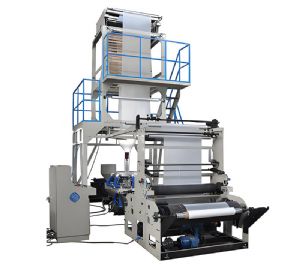
Blown Film Machine
Key technical parameters: output capacity 200-600 kg/h; film thickness 15-30 µm; lay-flat width up to 2 m; line speed 150-250 m/min. The BUR is typically 3.0-4.0 to maximize TD stretch. The melt temperature is around 200-220°C. The film's tensile strength (MD) should exceed 40 MPa, and elongation >300%. The tear resistance in both directions is critical. The cling force is measured in grams per inch. The film's clarity is less important than mechanical properties. The extruder must have a powerful motor to process high-viscosity LLDPE. The die must be precisely heated to avoid melt fracture. The air ring must deliver consistent cooling; any asymmetry causes gauge bands. The maintenance includes frequent cleaning of the die lip (cling additives are sticky) and regular inspection of the screw for wear. The line's energy consumption is significant; using energy-efficient components is recommended.
Market and operational insights: stretch film is one of the largest segments of blown film, with demand driven by logistics and e-commerce. The film is sold in hand rolls (for manual wrapping) and machine rolls (for automatic pallet wrappers). The trend is toward thinner films with higher pre-stretch ratios to reduce material usage. The use of recycled content in stretch film is increasing, but it requires careful compounding to maintain strength. The line's flexibility to produce different widths and thicknesses is important. The capital cost is moderate to high; payback is achieved through high volume. The operator must be skilled in managing the high-speed bubble and the cling additives. The film's quality is tested for stretch, puncture, and tear. The line can also produce colored films for branding. Overall, the stretch wrap extruder is a specialized but essential machine for the packaging industry, enabling secure and efficient palletizing. With continuous innovation in resin technology and process control, these lines are becoming more productive and versatile, meeting the growing demand for sustainable, high-performance stretch film.
