Silage wrap / agricultural silage film machine
A silage wrap film machine is a specialized blown film line dedicated to producing highly stretchable, puncture-resistant, and oxygen-barrier films used to wrap cylindrical bales of hay, grass, or corn silage. The film, typically 25-50 microns thick and 500-750 mm wide, is applied in multiple layers (4-8 wraps) to create an anaerobic environment that preserves the forage's nutritional value by inhibiting aerobic spoilage. The machine must process LLDPE or mLLDPE with high molecular weight, often with added ethylene vinyl alcohol (EVOH) or special barrier resins, to achieve the required oxygen transmission rate (OTR) of less than 100 cc/m²/day. The extruder is equipped with a barrier screw and a high-torque motor to handle the high-viscosity LLDPE. The die is usually an oscillating type to average out gauge variations. The cooling system is efficient, with IBC often used to increase output. The line speed is moderate (80-120 m/min) because the film is relatively thick and the bubble must be stable. The winder must produce rolls with consistent tension and good lay-flat, as uneven winding causes feeding problems on wrapping machines.
The key challenge in silage film production is achieving the balance between high stretchability (to conform to bale contours) and high puncture resistance (to withstand sharp stem edges) while maintaining low oxygen permeability. The film often has a multi-layer structure: a cling layer (for adhesion between wraps), a barrier layer (EVOH or high barrier PE), and a tough outer layer. 3-layer or 5-layer co-extrusion is common. The extruders are sized accordingly, with the barrier layer extruder being smaller. The film's color is usually black or white (white reflects sunlight to reduce heating, black blocks light to prevent algae growth). The additives include UV stabilizers for outdoor storage, slip agents for winding, and anti-block for handling. The thickness gauge with AGC ensures tight tolerance, as any thin spot compromises barrier performance. The line includes edge trimming and recycling, and a corona treater is optional for printing. The machine's control system stores recipes for different thicknesses and widths. The output capacity is typically 150-300 kg/h, and the lay-flat width ranges from 600 mm to 1500 mm.
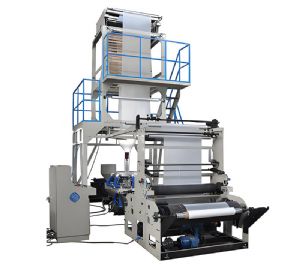
Blown Film Machine
Key technical parameters: melt temperature 200-230°C; BUR 2.0-3.0; frost line height 400-600 mm; die gap 1.0-1.8 mm. The film's tensile strength (MD) should exceed 35 MPa, elongation >400%, and tear resistance >80 g/µm. The oxygen barrier is critical – EVOH-containing films achieve OTR <20 cc/m²/day. The film's cling force (self-adhesion) must be sufficient to keep layers together without slipping. The line must handle the high melt strength of mLLDPE; a screw with a mixing section is recommended. The die should have a polished surface to avoid melt fracture. The air ring must provide uniform cooling; IBC is beneficial for high output. The winder must have a dancer roller to maintain constant tension. The maintenance includes regular cleaning of the die lip – the cling additives can be sticky. The screw should be inspected periodically for wear from abrasive fillers (if any). The line's energy efficiency is important; using variable frequency drives on blowers and motors reduces costs.
Operational and market aspects: silage film production is highly seasonal, with peaks in summer and autumn. Converters need to build inventory. The raw material cost is a major factor; using high-quality mLLDPE and EVOH is expensive, but necessary for performance. The trend is toward thinner films (to reduce material cost) with enhanced barrier using nano-fillers or new resin grades. Some machines now produce biodegradable silage films using PBAT/PLA blends, but these have lower barrier and strength. The operator must be skilled in managing the multi-layer die and the cling additives. Quality control includes testing for OTR, tear, and stretch. The line can also produce other agricultural films (mulch, greenhouse) with recipe changes. The investment is significant but justifiable given the stable demand from dairy and livestock farms. Overall, the silage wrap film machine is a specialized but essential tool for modern agriculture, enabling high-quality forage preservation and reducing feed waste. Its technology continues to evolve with advances in polymer science and automation, ensuring better film performance and easier handling for farmers.
