Screw feeding and blending ratio control
The accuracy of screw feeding and blending ratio control directly determines the consistency of film thickness, mechanical properties, and (in multi-layer lines) the functionality of each layer. The feeding system supplies raw material – virgin resin, masterbatch, reclaim, and additives – to the extruder screw at a controlled rate. In modern lines, gravimetric (weight-based) feeders are standard, replacing volumetric feeders because they compensate for bulk density variations and provide superior accuracy (±0.5% or better). A typical system includes several feeders for different components, all synchronized with the extruder screw speed. The total feed rate sets the extruder output (kg/h), which must match the line speed and die gap to achieve the target film thickness. For multi-layer lines, each extruder has its own feeding system, and the ratio of the feeders' outputs determines the layer thickness percentages. For example, in a 3-layer film with 20/60/20 distribution, the feeders for the two outer layers must each supply 20% of the total mass, while the core layer supplies 60%. These ratios must be maintained precisely; even a 2% drift can significantly alter film properties (e.g., seal strength or barrier). The control system uses a master setpoint (total output) and calculates individual feeder speeds based on the stored recipe ratios. Feeders are typically loss-in-weight type, where the weight loss over time is measured and the screw speed adjusted to maintain the target feed rate. This closed-loop control ensures stable output even with varying bulk density.
The screw feeding system must also handle different material types: pellets, regrind (flake), and powder (for certain additives). Regrind is less dense and more variable, so gravimetric feeders are essential. The feeders must be designed to prevent bridging or rat-holing – using agitators, vibrators, or special hopper geometry. The feed rate must be synchronized with the extruder screw speed; if the screw speed changes (e.g., to adjust thickness), the feeders should proportionally adjust to maintain the same output per revolution. Some lines use an advanced cascade control where the extruder speed is slaved to the total feed rate to maintain constant melt pressure. For blends, the ratio of components must be consistent; any variation affects properties like color, UV stability, or slip. The feeders should be calibrated regularly using a calibrated scale and a stopwatch – collect material for a set time and weigh it. Calibration frequency depends on the material; regrind may require more frequent checks. The blending ratio control also integrates with the reclaim system – if reclaim feed fluctuates, the virgin feeder compensates to maintain total output. In summary, screw feeding and blending ratio control is the foundation of a stable extrusion process. Properly maintained and calibrated feeders ensure that the film meets specifications and reduces scrap from off-spec material.
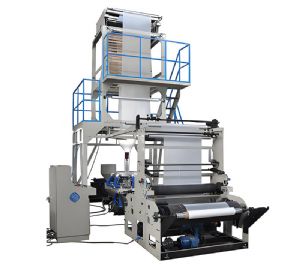
Blown Film Machine
Key practices for accurate feeding and blending: – Use loss-in-weight feeders for each component, not volumetric. – Set feeder alarms for low or high rate deviations. – Regularly clean feeders to prevent material buildup that affects accuracy. – Verify layer ratios by collecting and weighing extrudate from each extruder (if possible) or by measuring layer thickness using NIR gauging. – For multi-layer lines, use a master-slave control where the total output setpoint drives individual feeders. – Adjust feeder parameters if resin supplier changes (bulk density may differ). – Keep a log of feeder calibration values and drift trends. – Train operators to recognize feeding issues (e.g., surging due to hopper bridging) and to clear jams quickly. – Use a surge bin between reclaim and feeder to smooth out reclaim flow. In addition, the screw itself plays a role in feeding – a barrier screw with a grooved feed section enhances solids conveying, making the process less sensitive to feed variations. However, even the best screw cannot compensate for poor feeding control. Therefore, invest in high-quality feeders and maintain them diligently. For high-end barrier films, where layer ratios are critical, some lines use an online NIR gauge to measure each layer's thickness and feed that back to the individual feeders, creating a closed-loop layer ratio control – this is the ultimate in precision. In conclusion, screw feeding and blending ratio control is not an afterthought but a core process control element. With proper equipment and regular attention, it ensures consistent output and minimal waste, directly contributing to the profitability and quality reputation of the blown film line.
