Plastic film extrusion line
A plastic film extrusion line is a fully integrated production system that includes not only the extruder and die but also upstream (drying, blending, conveying) and downstream (cooling, collapsing, winding, and packaging) equipment. The line begins with a raw material handling system: silos for virgin resin, gravimetric blenders for additive mixing, and vacuum or desiccant dryers for hygroscopic materials like PA or EVOH. The blended material is fed into the extruder hopper via a vacuum loader or conveyor. The extrusion section consists of the barrel, screw, screen changer, and melt pump, followed by the die and air ring. This integrated chain ensures that the melt reaches the die at consistent temperature, pressure, and composition.
The downstream section of a plastic film extrusion line starts with the bubble formation and cooling zone. After the bubble is collapsed by the collapsing frame, the film passes through nip rollers that set the line speed. Then it goes through a thickness gauge scanner that provides real-time feedback to the die's automatic gauge control (AGC). After gauging, the film may pass through a corona treater to improve wettability, then to edge slitters that trim the non-uniform edges, and finally to a winder that produces finished rolls. Some lines also include a secondary slitting-rewinding unit for converting large master rolls into smaller customer rolls. Additionally, reclaim systems recycle edge trim back to the extruder feed via a granulator and pneumatic conveyor, reducing material waste. The entire line is controlled by a centralized PLC/HMI system that monitors temperatures, pressures, speeds, and thickness data, allowing operators to manage the process from a single panel.
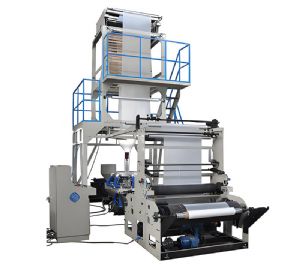
Blown Film Machine
Key performance indicators for a plastic film extrusion line include overall output (kg/h), film thickness tolerance (often ±5% of target), line efficiency (uptime percentage), and energy consumption per kg of film. To achieve high efficiency, the line must be balanced – the extruder output must match the haul-off speed and winder capacity. Bottlenecks often occur at the cooling system (air ring or IBC) or the winder turret indexing time. Therefore, line design involves careful selection of each component's capacity. For example, a high-output line (500 kg/h or more) requires large diameter screws (≥120 mm), high-capacity air blowers, and heavy-duty winders with automatic roll transfer. The die diameter also scales with output; larger dies allow higher output but require more precise temperature control. Line speed ranges from 20 m/min for heavy gauge (200 µm) to over 200 m/min for thin film (10 µm). The integration of IBC and automatic gauge control can increase output by 20-30% while reducing gauge variation.
In practice, a plastic film extrusion line is tailored to the end-product. For agricultural film (greenhouse, mulch), the line may include UV stabilizer addition and a wider die (up to 4m lay-flat). For shrink film, the line may have a special cooling configuration to achieve high orientation. For medical barrier films, the line includes cleanroom enclosures and sterile air filtration. The choice between a single-layer or multi-layer line depends on required properties: multi-layer lines add complexity but enable combination of seal, barrier, and structural layers. Installation of a plastic film extrusion line requires significant floor space (often 20-40 meters long) and utilities: cooling water, compressed air, and high-power electricity. Commissioning involves fine-tuning all parameters to achieve target film properties. With proper maintenance and operator training, a well-designed plastic film extrusion line can run reliably for over a decade, producing consistent quality film for diverse markets. The trend toward Industry 4.0 has brought predictive analytics, remote monitoring, and automated recipe management to modern lines, further boosting productivity.
