Number of layers (single / 3-layer / 5-layer / 7-layer / 9-layer)
The number of layers in a blown film line refers to how many individual polymer streams are combined in the die to form a single multilayer film. Lines range from single-layer (monolayer) for basic applications up to 9-layer or even 11-layer for high-performance barrier films. Single-layer film is the simplest and most economical, using one extruder and one die to produce film with uniform composition – suitable for garbage bags, liners, and general packaging where no special barrier or sealing properties are needed. However, single-layer films cannot combine incompatible materials (like PA and PE) without blending, which often degrades properties. As the layer count increases, each layer can be assigned a specific function: a seal layer (inside), a structural layer (core), a barrier layer (e.g., EVOH), and an outer layer (for printability or toughness). The most common multi-layer configurations are 3-layer (A/B/A symmetrical or A/B/C functional), 5-layer, and 7-layer. Nine-layer lines are typically used for very sophisticated packaging requiring multiple barriers and tie layers, such as meat and cheese packaging, where oxygen and moisture barrier are critical.
The choice of layer count is driven by the required film properties and cost. A 3-layer line can already provide a significant upgrade over monolayer by using a high-performance sealant on the inside (e.g., LLDPE or metallocene PE) and a tough outer layer (e.g., HDPE or PA), with a core layer that can contain recycled content or filler to reduce cost. For most packaging films, 3-layer is the sweet spot – offering good properties at moderate investment. 5-layer lines add two more tie or barrier layers, allowing the incorporation of EVOH for oxygen barrier or nylon for puncture resistance, while still separating them from the sealant and outer layers with adhesive tie layers. This configuration is common for shrink films and vacuum packaging. 7-layer lines further refine the structure, enabling multiple barrier layers or distributed functional additives, and are used for high-end food and medical packaging. 9-layer lines are the top tier, offering extreme flexibility to include several barrier layers, different sealants, and even recycled content without compromising performance, but they require multiple extruders (up to 9) and complex feed blocks, making them expensive and requiring skilled operators. The layer count also affects gauge control – more layers allow better distribution of thickness variations because each layer's output can be adjusted independently, improving overall uniformity. However, each additional layer adds complexity in melt temperature and viscosity matching; incompatible viscosities cause interfacial instability.
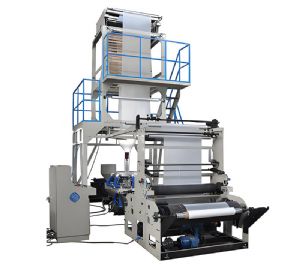
Blown Film Machine
Key technical considerations for each layer count: single-layer lines use one screw and one die, simplest maintenance and lowest cost, but limited to resins that can be blended. 3-layer lines typically use three extruders with diameters proportional to each layer's required thickness percentage; common structures are A/B/A (symmetrical) for balanced properties or A/B/C for functional films. 5-layer lines add two extruders for tie and barrier; feed block or multi-manifold dies are used to combine melts. 7-layer and 9-layer lines require precise temperature and pressure control for each melt stream, often with individual melt pumps. The die design must distribute all layers uniformly; stack dies with spiral mandrels are preferred for high layer counts. Layer ratio accuracy is critical – deviations cause property shifts; modern lines use gravimetric blending and feedback control to maintain ratios. The number of layers also influences the bubble stability: more layers mean thicker total film, which may require more cooling. Additionally, each layer's material must be compatible – incompatible polymers delaminate; tie layers (e.g., adhesive resins like maleic anhydride grafted PE) are essential between barrier and polyolefins. The investment cost roughly scales with the number of extruders and die complexity; a 7-layer line can cost 3-4 times a single-layer line.
Practical application guidelines: for commodity films (bags, liners), single-layer is sufficient. For high-strength packaging (shrink, heavy-duty sacks), 3-layer offers better tear and seal performance. For food packaging requiring oxygen barrier (meat, cheese), 5-layer with EVOH is standard. For medical and high-barrier flexible packaging, 7-layer or 9-layer provide multiple barriers and high performance. When selecting a layer count, also consider the future need for recycled content – inner layers can safely contain post-consumer recyclate without affecting seal or outer appearance. The number of layers also affects scrap rate; more layers mean more complex start-ups and higher changeover scrap, but better property uniformity reduces overall waste. Operator training is essential for multi-layer lines; understanding each resin's rheology and temperature window is key. In summary, choose the layer count that meets your required property profile with the minimum complexity to achieve target cost and quality. Many converters start with 3-layer and later upgrade to 5-layer by adding extruders and die sections, provided the line is designed modularly. Ultimately, the layer count is a strategic decision that balances performance, investment, and operational expertise.
