Multi-layer co-extrusion blown film line
A multi-layer co-extrusion blown film line is an advanced production system that combines two or more polymer melts from separate extruders into a single film with distinct layers, each contributing specific properties. This technology enables the production of films that cannot be achieved with monolayer extrusion – for example, combining a sealable inner layer, a barrier middle layer (EVOH or PA), and a tough outer layer. The line typically includes two to nine extruders, each feeding a layer, a feed block or multi-manifold die to combine the melts, a co-extrusion die, and downstream equipment. The layer distribution is controlled by each extruder's output, and the overall film thickness is governed by the total melt flow and line speed. Multi-layer lines are the standard for high-value packaging applications like food, medical, and industrial films where performance and material efficiency are critical. The investment cost is significantly higher than single-layer, but the added value justifies the expense for many converters.
The heart of a multi-layer co-extrusion line is the die and feed block system. In a feed block design, the individual melt streams are combined into a single stratified flow before entering the die, which then spreads the composite melt into a tube. This is common for up to 5 layers. For more layers or when materials have very different rheologies, a multi-manifold die is used, where each layer has its own spiral mandrel and the layers are combined only at the die lip. This provides better control over each layer's distribution and temperature. The extruders must be sized proportionally to the layer thickness percentages – for example, a 3-layer film with 20% sealant, 60% core, and 20% outer layer would have extruders with outputs in that ratio. Each extruder has its own temperature profile optimized for its resin. The melt pumps are often used to ensure stable flow independent of screw speed. The control system must coordinate all extruders, pumps, and the haul-off to maintain layer ratios within ±1-2%. The bubble stability can be more challenging with multi-layer melts because different viscosities affect the flow; therefore, the resins' melt flow indices must be matched or tie layers used.
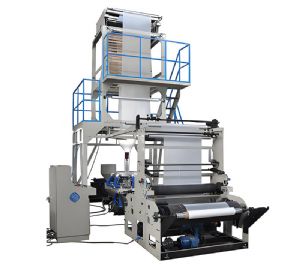
Blown Film Machine
Key advantages of multi-layer co-extrusion: ability to use costly barrier resins only where needed (thin layer), incorporation of recycled content in core layers without affecting surface properties, enhanced mechanical properties through layer orientation, and better seal integrity. Typical layer structures: A/B/A (symmetrical) for balanced properties, A/B/C for functional (e.g., sealant/barrier/outer), and A/B/C/D/E for complex packaging. The number of layers is chosen based on required properties – 3-layer is the minimum for adding barrier, 5-layer allows tie layers to bond incompatible polymers, 7-layer enables multiple barriers and fine-tuning. The line speed and output are comparable to single-layer lines of similar total throughput, but the gauge control must account for each layer's uniformity. Automatic gauge control (AGC) can adjust individual extruder outputs or the die gap to correct overall thickness, but layer-specific thickness measurement (e.g., NIR) is needed for precise control. Maintenance is more intensive due to multiple screws, pumps, and the complex die; cleaning requires purging compounds and sometimes disassembly. The line's flexibility to change layer structures is a key selling point – a 5-layer line can produce 3-layer film by turning off extruders, offering production versatility.
Applications for multi-layer co-extrusion lines are vast: food packaging (shrink bags, vacuum pouches, cheese wrap) requires oxygen and moisture barrier; medical packaging needs sterility and puncture resistance; automotive films need toughness and chemical resistance; agricultural films can combine UV stability with strength. The trend is toward thinner high-performance films using 7-layer or 9-layer lines to reduce material usage while maintaining properties. Sustainability is driving the use of recycled content in core layers, which multi-layer lines enable without affecting food-contact surfaces. When selecting a multi-layer line, consider the resin compatibility – tie layers (e.g., maleic anhydride grafted PE) are often required between polar (EVOH, PA) and non-polar (PE, PP) layers. The die diameter and BUR range must suit the target lay-flat width. Also, the line must have adequate cooling – IBC is almost standard for multi-layer high-output lines to handle the additional heat from multiple melts. Operator training is essential because troubleshooting multi-layer defects (delamination, interfacial instability) requires understanding of rheology and temperature windows. Overall, multi-layer co-extrusion lines represent the pinnacle of blown film technology, enabling the creation of films with tailored properties that meet the most demanding packaging requirements.
