Melt temperature control
Melt temperature control is one of the most critical process parameters in blown film extrusion, as it directly affects melt viscosity, flow stability, bubble formation, and final film properties. The melt temperature is determined by the extruder barrel's heating zones (typically 4-6 zones), the screw speed (shear heating), and the die temperature. The goal is to achieve a homogeneous melt temperature within ±1°C across the melt stream, because temperature variations cause viscosity differences that lead to gauge bands, melt fracture, or degraded mechanical properties. Each resin has an optimal processing temperature range – for LDPE, typically 160-200°C; LLDPE, 180-220°C; HDPE, 190-230°C; PA, 230-260°C; and EVOH, 190-220°C. Exceeding the upper limit causes thermal degradation (yellowing, gels, black specks), while too low temperature increases viscosity, causing high motor torque and poor melt homogeneity. Therefore, temperature control must be precise and stable, using PID controllers with thermocouples located in the barrel and at the adapter and die.
The temperature profile along the barrel is typically set with a rising gradient: feed zone cooler (to prevent bridging), compression zone hotter (to melt the polymer), and metering zone slightly lower (to homogenize). For example, for LLDPE, a profile like 160/180/200/200/190°C (feed to die) is common. The die temperature is usually set near the metering zone temperature or slightly higher to avoid freeze-off at the die lip. For multi-layer lines, each extruder may have a different temperature profile based on its resin; the die must be set to a compromise temperature that works for all layers. The melt temperature is measured at the adapter or immediately before the die using a thermocouple; some lines use infrared sensors for non-contact measurement. Operators monitor melt temperature trends; a sudden rise may indicate screw wear or screen clogging, while a drop may indicate a heater failure or cooling water leak. Automatic temperature controllers adjust heater power to maintain setpoints; cooling (water or air) is used to prevent overshoot, especially on the feed zone and at the die.
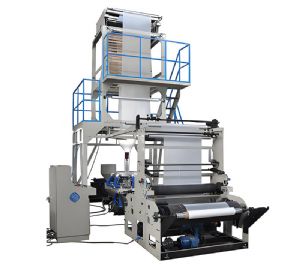
Blown Film Machine
Key factors affecting melt temperature control include screw design (barrier screws generate more shear, raising melt temperature), screw speed (higher speed increases shear heating), and back pressure (higher pressure raises melt temperature). Ambient temperature and water temperature variations also affect the barrel cooling efficiency. To achieve tight control, many lines use water-cooled barrels with solenoid valves that regulate cooling flow; oil heating is sometimes used for high-temperature applications. The melt temperature directly influences viscosity – higher temperature lowers viscosity, which improves flow and reduces pressure, but may reduce bubble stability. Conversely, lower temperature increases viscosity, which helps bubble stability but may cause melt fracture at high speeds. For thin films, a higher melt temperature is often needed to maintain flow at high speed; for thick films, lower temperatures reduce sagging. The temperature must be uniform across the die circumference; temperature variations as small as 2°C can cause thickness deviations. Therefore, the die is divided into multiple heating zones (e.g., 8-16 zones for large dies) with independent control. Advanced systems use thermal imaging to detect hot spots. Regular calibration of thermocouples and maintenance of heater bands (replace if output is inconsistent) are essential.
Practical advice for melt temperature control: always start with the resin manufacturer's recommended profile, then fine-tune based on actual melt temperature readings. Use the melt pressure reading as an indirect check – if pressure increases without screw speed change, melt temperature may have dropped. Keep a log of temperature setpoints and actual readings for each production run; this helps identify drift over time. When changing resins, purge thoroughly to avoid cross-contamination, and adjust profiles gradually to avoid thermal shock. Consider using a melt pump, which decouples pressure from screw speed, allowing more stable temperature control because the screw can run at optimal speed for heat input while the pump delivers steady flow. Also, ensure that the cooling system for the barrel (if water-cooled) has consistent inlet temperature; a chiller is recommended for precision. In summary, melt temperature control is a continuous balancing act – too hot degrades, too cold obstructs. Mastery of temperature profiles is a hallmark of efficient blown film production, directly impacting product consistency and machine uptime.
