Line speed (m/min)
Line speed, expressed in meters per minute (m/min), is the speed at which the film is pulled through the nip rollers and wound onto rolls. It is one of the primary control variables in blown film production because, for a given extruder output and bubble size, line speed inversely determines film thickness – higher speed yields thinner film, and lower speed yields thicker film. The line speed is set by the haul-off unit's nip roll rotation speed, and it is coordinated with the extruder screw speed and the bubble internal pressure to maintain target thickness and lay-flat width. Typical line speeds range from 10 m/min for very thick films (200+ µm) up to 300 m/min for ultra-thin films (10-20 µm) in high-speed packaging lines. However, practical speeds depend on the cooling capacity and bubble stability; too high a speed can cause the bubble to stretch excessively, leading to neck-in, gauge bands, or even bubble breakage. Therefore, line speed must be optimized in conjunction with cooling air flow, BUR, and melt temperature.
The relationship between line speed and thickness is governed by the mass conservation principle: output (kg/h) = line speed (m/min) × film width (m) × thickness (µm) × density (kg/m³) × 60 / 1,000,000 (with unit conversions). For a fixed output and width, increasing speed reduces thickness proportionally. For example, at 100 kg/h output, 1 m wide film, and density 0.92 g/cm³, a speed of 50 m/min gives thickness ≈ 100 / (50 × 1 × 0.92 × 0.06) ≈ 36 µm. To reduce thickness to 20 µm, speed must increase to about 90 m/min. However, the extruder output may not be sufficient to maintain that thickness at high speed – you may need to increase screw speed or use a larger extruder. Also, higher line speed demands faster cooling because the film spends less time in the cooling zone; otherwise, the frost line will move up, and the film may not be fully solidified before the nip, causing sticking or blocking. Therefore, high-speed lines are equipped with high-capacity air rings, IBC, and chilled air supplies to ensure adequate cooling.
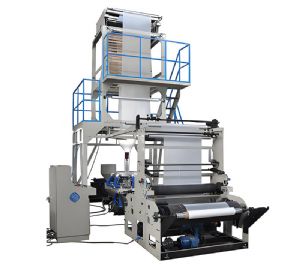
Blown Film Machine
Key parameters affecting line speed capability include the cooling system's heat removal rate, the resin's melt strength (higher melt strength allows faster drawing), the die design (to avoid melt fracture), and the winder's ability to handle rapid roll changes. For thin films (<20 µm), melt strength is critical – LLDPE with high molecular weight is preferred. For thick films (>100 µm), line speed is limited by the time needed for heat transfer; air cooling alone may not be sufficient, and some lines use water-cooled bubbles. The line speed also affects molecular orientation: higher speed increases MD orientation (draw ratio), which improves tensile strength in the machine direction but reduces tear resistance and may increase shrink. To achieve balanced properties, the draw ratio (ratio of haul-off speed to die exit speed) should be matched with BUR. Typically, the draw ratio is 5-15 for blown film. Operators adjust line speed gradually during start-up; sudden speed changes cause thickness spikes. Automatic control systems can ramp speed up or down following a recipe profile to minimize scrap. Additionally, line speed influences output – for a given extruder output, higher speed means more linear meters produced per hour, but the total weight output remains the same if thickness decreases. Therefore, for maximizing production (in kg/h), the limiting factor is extruder output, not line speed.
Practical advice for line speed control: always start at low speed and increase gradually while monitoring thickness, bubble stability, and frost line height. Use the gauge reading to adjust speed – if film is too thick, increase speed; if too thin, decrease speed. Ensure that the air ring blower speed is also adjusted to maintain frost line position; as speed increases, you may need more cooling air. Keep the nip roller pressure consistent to avoid slip; excessive pressure can squeeze the film and cause thickness marks. Regular calibration of the speed sensor (encoder) ensures accurate speed reading. In multi-layer lines, all extruders must synchronize speed to maintain layer ratios – any speed mismatch causes delamination or thickness shift. Many modern lines feature a master speed setpoint that scales all extruder speeds and haul-off speed together, simplifying operation. Finally, line speed should be chosen to balance quality and output – running at maximum speed may cause defects; running too slow reduces productivity. Optimization studies using design of experiments can identify the speed that gives best quality at acceptable output. Overall, line speed is a dynamic parameter that requires continuous monitoring and adjustment based on real-time process conditions.
