Lay-flat width
Lay-flat width is the width of the flattened film tube after the bubble is collapsed, measured in millimeters or inches. It is essentially half the circumference of the bubble, because the collapsed tube has two layers. Mathematically, lay-flat width = π × Bubble Diameter / 2. Since bubble diameter = Die Diameter × BUR (Blow-Up Ratio), we get the common formula: Lay-flat width = π × Die Diameter × BUR / 2. This is a fundamental relationship that determines the final width of the film as wound on rolls. For example, a die of 300 mm with a BUR of 3.0 yields a lay-flat width of π×300×3/2 ≈ 1413 mm (1.41 m). The lay-flat width is a key specification because it defines the maximum usable width of the film, and it must match the customer's required bag width or film sheet width. If the lay-flat width is too narrow, the film cannot be used; if too wide, it must be slit, wasting material. Therefore, the line must be set to produce the target lay-flat width consistently.
The lay-flat width is controlled by adjusting the internal bubble pressure (which changes BUR) and, to a lesser extent, the haul-off speed (which affects bubble diameter via neck-in). Operators measure the lay-flat width using a ruler or a laser sensor at the collapsing frame or after the nip. The target width is set based on the die diameter and the desired BUR; for instance, to produce 1200 mm lay-flat with a 250 mm die, BUR must be about 2×1200/(π×250) ≈ 3.06. The operator adjusts the internal air pressure until the measured width matches the target. During production, the lay-flat width should remain within ±5 mm; larger variations cause problems in downstream bag making. The width also depends on the film's orientation – higher BUR increases TD stretch, which can change the width slightly due to relaxation. Therefore, the width should be measured on the final roll after cooling and relaxation. Additionally, the lay-flat width affects the roll's diameter and weight; for a given thickness and density, wider rolls weigh more per linear meter.
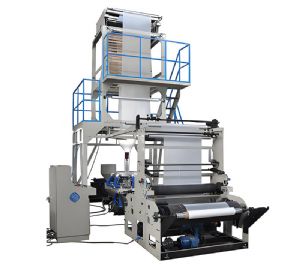
Blown Film Machine
Key factors affecting lay-flat width stability: bubble pressure fluctuations, air ring cooling non-uniformity, haul-off speed changes, and melt temperature variations. To maintain consistent width, most lines use an automatic lay-flat control that adjusts internal air pressure based on a width sensor. The sensor can be an ultrasonic or optical device that measures the bubble diameter or directly measures the collapsed width. The control loop also compensates for speed changes – if line speed increases, the width tends to decrease (because the bubble is pulled longer), so the system increases internal pressure to restore width. The die diameter is fixed, so the only adjustable variable is BUR (by pressure) and to some extent the draw ratio. For multi-layer films, the lay-flat width is the same for all layers, but each layer's thickness distribution affects the overall uniformity. The winding tension also interacts with width – high tension can narrow the film by stretching, so the winder tension must be controlled.
Practical considerations: when ordering a blown film line, the lay-flat width is a primary sizing parameter; choose a die diameter that can achieve the desired width at a moderate BUR (2.5-4.0) for stable operation. If you produce multiple widths on the same line, consider using an oscillating die or a variable BUR system. The collapsing frame must be wide enough to accommodate the maximum lay-flat width without wrinkles. For films that are slit into multiple ribbons, the lay-flat width determines the number of slits and the width of each ribbon. In bag making, the lay-flat width is the bag width (if side-seal bags) or half the bag width for bottom-seal bags. Therefore, it is a critical dimension that must be communicated accurately to customers. Regular calibration of the width sensor is necessary; also check that the collapsing frame is not pinching the film, which can reduce the effective width. In summary, lay-flat width is a key output variable that must be measured and controlled precisely to meet customer specifications and minimize waste.
