Lay-flat and slitting / rewinding process
After the blown film bubble is collapsed by the collapsing frame and passed through the nip rollers, it emerges as a flattened tube – the "lay-flat" film. This lay-flat film is typically wound as a full-width roll. However, many applications require narrower widths, or the film may need to be opened into a single sheet (if the tube is slit). The lay-flat and slitting/rewinding processes convert the master roll into finished rolls of specific widths and lengths. The lay-flat width is determined by the BUR and die diameter, as discussed earlier. The film must be flat and wrinkle-free; the collapsing frame's angle and nip roll alignment are critical for achieving a good lay-flat. After winding, the master roll may go to a slitter-rewinder, which is a separate machine (or integrated in-line). The slitter-rewinder unwinds the master roll, slits it into multiple narrower strips using circular knives or razor blades, and rewinds each strip onto individual cores. The slitting station must be precise; any blade misalignment causes rough edges or dust. The rewinding section has separate tension controls for each slit strip to maintain uniform roll hardness. The process can be done in-line (after the winder) or off-line. In-line slitting allows immediate production of finished rolls, reducing handling. However, it requires that the line speed and slitter speed are synchronized. Off-line slitting is more flexible for different widths and allows slower speed for better quality. The rewound rolls must have good density – too soft causes telescoping; too hard causes blocking. The tension profile is set based on film thickness and material. For thin films, lower tension is used. The lay-flat process also includes edge trimming (discussed earlier) to remove uneven edges. The trimmed edges are typically recycled.
Key quality aspects of lay-flat: the film should have no wrinkles, as wrinkles cause defects in printing or lamination. The collapsing frame's rollers should be adjusted so that the bubble is flattened symmetrically. If the bubble is not centered, one side will be longer, causing a "tilt" in the lay-flat. The nip roll pressure also affects lay-flat – uneven pressure can create diagonal wrinkles. Operators should check the lay-flat visually and adjust the collapsing frame angles. The film should also be free of static; static eliminator bars are often placed before the nip to prevent dust attraction. The slitting/rewinding process: the slitter-rewinder has an unwind brake to control tension, a slitting section with adjustable knives, and a rewind section with individual rewind stations. Each rewind station has a dancer roll for tension control. The knife settings must be accurate to ±0.5 mm. The blades should be changed regularly – dull blades cause ragged edges and dust (which contaminates the film). The rewinding process can produce rolls in various widths and lengths (meterage). The finished rolls are weighed and labeled. The slitter-rewinder can be a bottleneck if not sized for the line's output; it should have capacity to handle the maximum master roll diameter and weight. In summary, the lay-flat and slitting/rewinding process is the final step in transforming the blown film into a marketable product. Quality at this stage determines customer satisfaction – any defects in lay-flat or slitting will be visible in the final application.
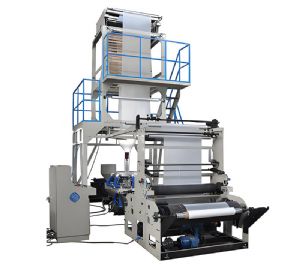
Blown Film Machine
Best practices: – Regularly inspect the collapsing frame for roller wear and alignment. – Use anti-static bars to reduce dust attraction. – For in-line slitting, ensure the knives are synchronized with line speed. – Monitor roll hardness – a durometer can measure it. – Adjust tension based on film thickness – thicker films need higher tension. – Keep the slitter blades sharp – replace them after every few rolls. – Clean the slitter dust periodically. – For high-quality films, use a razor blade slitting system for cleaner edges. – Train operators on slitter setup – width changeover should be quick. – Document settings for each product. – If the film has low slip, use a non-stick coating on the slitter anvil. In line with sustainability, some slitters have a reclaim system for edge trim (if not already done at the extruder). The lay-flat process also determines the film's final appearance – a good lay-flat gives a flat, smooth roll. Overall, lay-flat and slitting/rewinding are essential converting steps that add value to the blown film, making it ready for end-use. Investment in a good slitter-rewinder pays off through improved roll quality and fewer customer complaints.
