Lamination film blowing system
A lamination film blowing system is a blown film line specifically designed to produce films that serve as a top layer in lamination processes – adhering to other films, paper, or boards to provide protection, gloss, barrier, or printability. These films are typically made from BOPP (but blown process), PE, PP, or PET (though PET is usually cast), with thicknesses ranging from 15 to 100 microns. The line must produce films with excellent optical clarity, smooth surfaces, and consistent thickness to ensure uniform lamination. The extruder is a standard single-screw or co-extrusion (3-layer) type, with a barrier screw for homogeneity. The die is often oscillating to spread gauge bands. The cooling system must be very efficient to achieve high clarity – chilled air and IBC are common. The line speed is moderate (80-150 m/min). The film is wound on high-quality cores with strict tension control to avoid blocking (sticking to itself). The film may be corona-treated to enhance adhesion for the adhesive layer (in adhesive lamination) or may have a heat-sealable layer (in thermal lamination). The line often includes an in-line coating station to apply a primer or adhesive coating, but most lamination films are coated offline by the laminator. The film must have low haze and high gloss. The line's control system ensures tight gauge tolerance, as variations cause bubbles or wrinkles in lamination.
The key challenge is producing a film with perfect surface quality – no gels, die lines, or contamination – because any defect becomes visible and magnified in the final laminate. The extruder screw must be meticulously cleaned and the die polished. The cooling air must be filtered. The film's shrinkage must be low to prevent distortion in the laminating process. The line often uses a single-layer structure for simplicity, but 3-layer films can include a core layer with filler (for stiffness) and outer layers with additives for slip or anti-block. The film's coefficient of friction is controlled to allow smooth unwinding. The line may have a thickness gauge with AGC to maintain tolerance within ±2%. The winder must produce rolls with even tension; any telescoping causes lamination defects. The film is often slit to exact widths. The line's output ranges from 100-400 kg/h. The operator must regularly check film quality under a light table for defects. The maintenance includes frequent die cleaning and screw inspection.
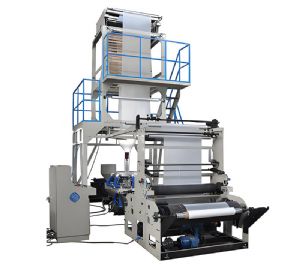
Blown Film Machine
Key technical parameters: film thickness 15-100 µm; lay-flat width 500-2000 mm; BUR 2.5-3.5; melt temperature 190-230°C; haze <5%; gloss >80%. The film's tensile strength and elongation must be sufficient for the laminating process. The corona treatment level (dyne level) is typically 38-42 dyne/cm for adhesion. The film's shrinkage at laminating temperature (usually 80-120°C) should be <2%. The line's energy consumption is moderate. The maintenance includes cleaning the die and air ring, and calibrating the corona treater. The operator must be trained to handle high-clarity films; any contamination causes scrap. The film can be produced with additives like UV blockers for outdoor use. The line can also produce lamination films for photovoltaic panels or protective films for electronics, requiring even higher purity.
Market and applications: lamination films are used in flexible packaging (pouches, bags), graphic films (banner, poster), and industrial laminates. The demand is growing with the packaging industry. The trend is toward thinner, higher-performance lamination films that reduce material cost. There is also a move toward sustainable lamination films, such as those made from bio-PE or with PCR content in the core (for non-food contact). The line's flexibility to produce different widths and thicknesses is important. The capital cost is similar to a standard packaging line. The profitability comes from selling to converters who add adhesive layers and then laminate to substrates. Overall, the lamination film blowing system is a specialized but versatile asset, producing the shiny, protective top layer that enhances the appearance and durability of countless products, from snack packets to posters. Its operation requires a focus on cleanliness and precision to meet the high-quality standards of the lamination industry.
