Internal bubble cooling (IBC)
Internal Bubble Cooling (IBC) is an advanced technology used in blown film extrusion to improve cooling efficiency by delivering chilled air inside the bubble. Unlike conventional external air rings that cool only the outer surface, IBC inserts a tube or pipe through the die center into the bubble, supplying cooled and conditioned air directly onto the inner surface of the molten film. This dual-sided cooling significantly increases the overall heat removal rate, allowing higher line speeds and thicker films without extending the frost line height or causing bubble instability. IBC systems typically include an air chiller, a blower, a filtration unit, and a control system that regulates the flow and temperature of the internal air. The cooling air is evenly distributed inside the bubble via a star-shaped or annular manifold, and the air exits through the top of the bubble (via a vent) or is recirculated. The key benefits are increased output (20-40% higher for the same bubble size), improved thickness uniformity (because faster cooling reduces gauge variations), and the ability to process heat-sensitive resins with lower melt temperatures.
The principle of IBC is based on enhanced heat transfer – the molten film is cooled from both sides, so the temperature gradient is steeper, solidifying the polymer faster. This allows the line speed to be increased while maintaining the same frost line height, or the frost line can be lowered for a given speed, improving bubble stability. Additionally, IBC reduces the required external cooling air, which can lower energy consumption and noise. However, IBC requires careful control of the internal air pressure and flow to avoid collapsing or over-expanding the bubble. The internal pressure is typically maintained slightly above atmospheric (e.g., 200-500 Pa) to keep the bubble inflated, and the internal air temperature is set between 5°C and 15°C depending on the film thickness and material. The system must be integrated with the bubble pressure sensor and the haul-off speed controller to maintain constant lay-flat width. When line speed changes, the IBC flow must be adjusted proportionally to maintain the frost line position. Modern IBC systems have PLC-based control that automatically matches internal cooling to output variations.
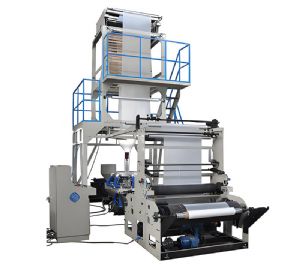
Blown Film Machine
Key components of an IBC system: a chilled water or air chiller to cool the internal air, a high-efficiency blower to deliver the air, a distribution manifold inside the bubble, and a venting system to release the warmed air. The IBC tube is typically made of stainless steel and extends up to the frost line; its diameter is about 10-20% of the bubble diameter. The internal air flow rate is typically 10-30% of the external air flow. The internal air must be filtered to prevent contamination of the film surface. Temperature sensors monitor the air entering and exiting the bubble; the exit air temperature indicates cooling efficiency. The system also includes a dew point controller to avoid condensation on the film – condensation causes haze and streaks. IBC is most effective for films over 30 µm and for high-output lines; for thin films (<20 µm), the benefit is smaller because the film cools quickly anyway. The investment cost for IBC can be substantial (adding 20-30% to the line cost), but the payback is often less than 18 months due to increased output and reduced scrap.
Installation and operation of IBC: the IBC system must be retrofitted during die design – the die must have a central opening for the IBC tube. The tube is suspended from the top of the tower and adjusted vertically to position the air outlets inside the bubble. During start-up, the internal air flow is gradually increased as the bubble forms. The operator must balance internal and external cooling to avoid excessive cooling that causes brittleness. The internal air pressure is controlled by a differential pressure sensor; if pressure drops, the bubble may collapse; if too high, the bubble may burst. Therefore, IBC systems are equipped with emergency release valves. Regular maintenance includes cleaning the internal tube and checking for leaks. The chiller must maintain consistent temperature; any temperature fluctuation causes thickness variation. Many IBC systems also include an automatic lay-flat control that adjusts internal air to maintain constant width despite changes in output or speed. Overall, IBC is a proven technology that significantly enhances the productivity and quality of blown film lines, especially for high-value applications like shrink film and agricultural film where uniformity and strength are paramount.
