Internal bubble cooling (IBC) process
Internal Bubble Cooling (IBC) is a process enhancement that introduces chilled air into the interior of the blown film bubble, complementing the external air ring cooling. The IBC process involves a tube inserted through the die center that delivers cooled, conditioned air onto the inner surface of the molten film. This dual-sided cooling dramatically increases the heat transfer rate, allowing higher line speeds (20-40% increase) and better thickness uniformity because the cooling is more symmetrical and rapid. The IBC process is controlled by regulating the flow rate and temperature of the internal air. The flow rate determines the cooling intensity – more air lowers the frost line; less air raises it. The temperature of the internal air is typically set between 5°C and 15°C, achieved via a chiller. The internal air also creates a slight positive pressure inside the bubble, which helps stabilize the bubble and control lay-flat width. The IBC system includes a blower, a chiller, a distribution manifold (inside the bubble), a pressure sensor, and a control valve. The control algorithm maintains a constant frost line height by adjusting internal air flow in response to changes in line speed, output, or external temperature. For example, if line speed increases, the system increases internal air flow to keep the frost line at the setpoint. The IBC process is particularly beneficial for thick films (50+ µm) and high-output lines, where external cooling alone is insufficient.
The IBC process must be carefully tuned to avoid problems. Too much internal air can cause the bubble to become too cold, leading to brittleness or haze; too little air reduces the output gain. The internal air distribution must be uniform – if one side receives more air, the bubble becomes asymmetric. The distribution manifold has multiple outlets to spread air evenly. The internal air pressure is typically maintained at 200-500 Pa above atmospheric; the pressure sensor provides feedback. The IBC control system often includes a dew point sensor to prevent condensation, which would cause water spots on the film. The internal air is dried before cooling. The IBC process interacts with external air ring settings – if internal cooling is increased, external cooling may be reduced to maintain balanced cooling. The operator should adjust both in tandem. Some advanced lines have an automatic IBC control that uses a camera to measure frost line height and adjusts internal air flow accordingly. The process also reduces energy consumption per kg because the line runs faster for the same extruder output. In summary, the IBC process is a powerful tool that transforms a standard line into a high-productivity system, enabling output levels that would otherwise require a larger extruder. Its proper implementation and tuning are essential for maximizing the return on investment.
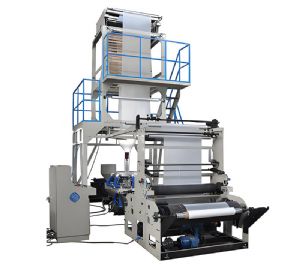
Blown Film Machine
Key IBC operating parameters and tuning tips: – Set internal air temperature to 5-15°C; lower for thicker films. – Start with internal air flow at 10-20% of external air flow, then adjust based on frost line. – Maintain dew point below -10°C to avoid condensation. – Balance internal and external cooling so that frost line is stable and bubble is cylindrical. – If bubble becomes unstable, reduce internal air flow slightly. – If film haze increases, reduce internal cooling or increase melt temperature. – Use a pressure sensor to monitor internal pressure; adjust the exhaust valve to maintain setpoint. – For multi-layer films, IBC is often essential because total thickness is higher; tune for the slowest-cooling layer. – Calibrate the internal air flow meter regularly. – Clean the IBC tube periodically to prevent buildup. The IBC process also affects the lay-flat width – higher internal air flow (more cooling) tends to shrink the bubble, so you may need to increase internal pressure to maintain width. The control system can automatically compensate. In conclusion, IBC is a mature technology that, when properly operated, delivers significant gains in output and quality. Operators should be trained in its principles and troubleshooting. With IBC, a line can achieve speeds that were previously unattainable, making it a competitive necessity for high-output producers.
