Internal bubble cooling (IBC) film extruder
An internal bubble cooling (IBC) film extruder is a blown film line equipped with a system that delivers chilled air into the interior of the bubble to enhance cooling from both sides, complementing the external air ring. The IBC system typically includes a chiller, a blower, a distribution tube inserted through the die center, and a control unit. The cooled air (5-15°C) is directed onto the inner surface of the molten film, accelerating solidification and allowing the line to run at higher speeds or produce thicker films without increasing the frost line height. IBC is particularly beneficial for high-output lines and for films that require tight gauge control. The extruder itself is similar to a standard unit but must have a die with a central passage for the IBC tube. The screw and barrel are sized to provide the melt flow that IBC enables – often 20-40% higher output than without IBC. The control system integrates IBC air flow and temperature with the extruder speed and haul-off to maintain stable bubble dimensions. The system also includes a vent to exhaust the warmed internal air, which can be recirculated after cooling.
The primary advantage of IBC is the significant increase in cooling capacity, which translates to higher line speeds and/or thicker films. For example, a line that produces 300 kg/h without IBC may achieve 400 kg/h with IBC while maintaining the same film quality. The internal cooling also reduces the temperature gradient across the film thickness, improving uniformity and reducing internal stress. This often results in better optical properties (lower haze) and mechanical properties (higher tear strength). The frost line becomes more stable, and bubble oscillation is reduced. The IBC system also allows finer control of the bubble shape; by adjusting internal air flow, operators can fine-tune the lay-flat width and gauge profile. The system is especially valuable for multi-layer films where different layers have different cooling requirements. The investment cost for IBC is significant (20-30% of the line cost), but the payback is often less than 18 months due to the output gain and material savings from improved gauge control.
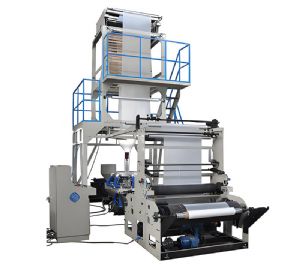
Blown Film Machine
Key components and parameters of an IBC film extruder: the chiller must provide a consistent supply of chilled air at the required temperature and flow rate – typically 100-500 m³/h depending on bubble size. The distribution tube has multiple outlets to ensure uniform air distribution inside the bubble; its position is adjustable vertically. The internal air pressure is regulated by a pressure transducer and a valve, maintaining a slight positive pressure (200-500 Pa). The system includes a filter to prevent contamination. The control algorithm ties IBC air flow to line speed – faster speed requires more cooling air to maintain frost line position. The IBC system also includes a dew point controller to avoid condensation, which would cause haze. The extruder's melt temperature may be slightly lower with IBC because the faster cooling allows less thermal degradation. The die must be designed to accommodate the IBC tube without disrupting melt flow; this often requires a modified die body. The maintenance of IBC includes cleaning the distribution tube and checking for leaks. The chiller must be regularly serviced; its cooling capacity should match the line's maximum output. The system can be retrofitted to existing lines, but it requires die modification and additional control hardware.
Operational tips for IBC: during start-up, introduce internal air gradually after bubble formation; too much air can burst the bubble. The internal air flow should be adjusted to maintain the frost line at the same height as without IBC, or slightly lower. The relationship between internal and external cooling must be balanced – if internal cooling is too aggressive, the film may become brittle; if too weak, the benefit is small. The system should be integrated with AGC so that changes in line speed automatically adjust internal air. Regular monitoring of the internal air temperature and flow rate is essential; any drift affects film properties. The IBC system can also help produce films with more balanced MD/TD properties by controlling cooling asymmetry. For recycling, IBC helps process higher percentages of PCR because the enhanced cooling reduces the risk of gels. Overall, the IBC film extruder is a powerful upgrade for lines seeking higher productivity and better quality. It is now standard on most new high-output lines and is increasingly common on retrofits, representing a key technology for competitiveness in the blown film industry.
