Industrial liner film extrusion
Industrial liner film extrusion refers to the production of thick, heavy-gauge films (typically 100-300 microns) used for various industrial purposes, including pond liners, pit liners, tank covers, construction vapor barriers, and protective floor coverings. These films are made from HDPE, LLDPE, or LDPE, often with UV stabilizers and antioxidants for outdoor durability. The extrusion line is a heavy-duty blown film system with a large extruder (diameter 100-200 mm), a high-torque gearbox, and a powerful motor to process high-viscosity melts. The die is large (400-800 mm) to produce wide films (up to 6 meters lay-flat). The cooling system is robust, often with IBC to handle the thick film's heat. The line speed is low (10-30 m/min) because of the thickness. The winder is a heavy-duty turret type capable of handling rolls weighing over 1000 kg. The film is often produced as a single-layer or co-extruded (3-layer) with a core layer containing recycled content and outer layers providing protection. The applications require high tensile strength, tear resistance, and puncture resistance. The line also includes a thickness gauge with AGC to maintain uniform gauge, as any thin spot compromises the barrier function.
The extrusion of industrial liner film demands high melt strength to prevent sagging of the thick bubble. The screw is a high-compression barrier type, often with a mixing section. The temperature profile is set higher (200-240°C) to reduce viscosity and ease flow. The die gap is wider (1.5-3.0 mm) to accommodate the thick film. The air ring must deliver uniform cooling; IBC is highly recommended to speed up solidification. The collapsing frame and nip rollers are oversized to handle the heavy film. The film's mechanical properties – tensile strength (MD/TD), elongation, tear resistance, and impact – are tested per ASTM standards. The film may be embossed or textured for anti-slip properties. The line includes edge trimming and recycling. The control system is sophisticated, with multiple zones for temperature and pressure. The maintenance includes regular cleaning of the die, inspection of the screw for wear, and calibration of the thickness gauge. The line's energy consumption is significant; using high-efficiency motors and heat recovery reduces costs. The film can be colored black for UV protection or white for reflectivity.
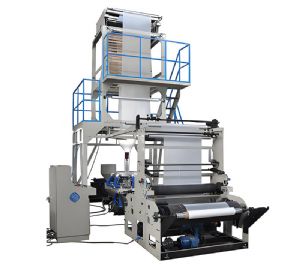
Blown Film Machine
Key technical parameters: output capacity 300-800 kg/h; film thickness 100-300 µm; lay-flat width up to 6 m; line speed 10-30 m/min; BUR 2.5-3.5; frost line height 400-600 mm. The resin is typically HDPE for stiffness or LLDPE for toughness; blends are common. The film's tensile strength should exceed 25 MPa in both directions. The tear resistance is critical for puncture prevention. The UV stabilizers are added as masterbatch; content 2-5%. The die temperature is maintained within ±1°C to ensure uniform flow. The air ring blower capacity is large; the air velocity at the lip is 20-40 m/s. The winder tension is controlled to avoid stretching. The line's footprint is larger due to the tall bubble tower (10-15 m). Maintenance is scheduled based on run hours; automatic lubrication systems are often installed. The line can be retrofitted with additional extruders for multi-layer capability. The quality control includes checking for gels and pinholes using a pinhole detector.
Market and operational aspects: industrial liner films are used in mining, agriculture, construction, and environmental protection. The demand is stable and often project-based. Converters need to produce films to specific dimensions and thicknesses. The line's flexibility to change width and thickness is important. The raw material cost is a major factor; using recycled content in the core reduces cost but may affect quality. The trend is toward thicker films with higher strength using advanced polyethylenes. The line operator must be skilled in handling thick bubbles; any instability causes costly downtime. The line's investment is high, but the margins are decent due to the value-added nature. Many industrial liner lines are located near large mining or construction sites to reduce logistics. The film can be produced in rolls or as continuous sheets for field welding. Overall, industrial liner film extrusion is a specialized segment that requires robust equipment and careful process control to produce films that provide reliable containment and protection in demanding environments.
