How to increase output (kg/h) on blown film line
Increasing output (kg/h) is a primary goal for blown film converters to improve productivity and reduce cost per kg. Output is determined by the extruder's throughput, which depends on screw design, screw speed, and melt density, but is limited by cooling capacity, die design, and downstream equipment. To increase output, you need to identify the bottleneck in your line – is it the extruder (max screw speed, torque, or melt temperature), the cooling (air ring, IBC), the die (pressure drop), or the winding speed? A systematic approach starts with measuring current output at maximum stable conditions, then testing incremental changes. The simplest way to increase output is to increase screw speed (RPM) if the extruder motor has spare torque and the screw is not surging. However, increasing screw speed raises melt temperature due to shear heating, which may degrade the resin or reduce bubble stability. Therefore, you may need to adjust the barrel temperature profile – lower the setpoints to compensate for the extra shear heat, or add barrel cooling. Also, ensure the feed hopper can supply enough resin at the higher speed – a gravimetric feeder with good throughput is essential. Another method is to increase the die gap – a wider gap reduces pressure drop, allowing higher flow for the same screw speed, but it also increases film thickness unless you also increase haul-off speed. So, output can be increased by raising both screw speed and line speed proportionally to maintain thickness.
Cooling is often the limiting factor. Increasing output means more heat must be removed from the bubble. Upgrading the air ring to a high-efficiency dual-lip design, adding chilled air (cooling the blower intake), or installing IBC (internal bubble cooling) can significantly increase cooling capacity, allowing 20-40% higher output. IBC is one of the most effective upgrades – it cools the bubble from the inside, enabling higher line speeds without increasing frost line height. Another approach is to use a larger die – a larger die allows a higher melt flow for the same pressure, but it also increases the bubble size, requiring more cooling. Changing the resin to a lower viscosity grade (higher MFI) can also increase output for the same screw speed, but it may affect mechanical properties. Using a melt pump (gear pump) between the extruder and die can increase output by decoupling pressure from screw speed, allowing the extruder to run at its maximum throughput while the pump maintains steady flow. This can boost output by 10-20%. Also, ensure the screen changer has adequate area – a clogged screen increases backpressure, reducing output; use a larger screen pack or a continuous screen changer.
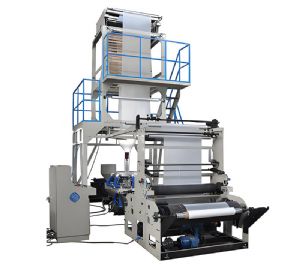
Blown Film Machine
Operational adjustments: check that the barrel heating zones are not at maximum – if they are, you may need more powerful heaters or better insulation. Increase the feed zone temperature to improve solids conveying. Optimize the screw design – a barrier screw or a screw with a mixing section can improve melting efficiency, allowing higher output without increasing screw speed. If you have a grooved feed extruder, it already provides higher output. Also, ensure the nip roller pressure is adequate to pull the film without slipping; if it slips, the actual line speed is lower than setpoint, reducing output. The winder speed must match the line speed – if the winder is the bottleneck, upgrade to a faster turret winder. For multi-layer lines, balancing layer outputs is crucial; if one extruder limits the total, you may need to upgrade that extruder. Another simple trick is to increase the haul-off speed while keeping screw speed constant – this produces thinner film, but for the same output (kg/h), the linear speed increases, which may be beneficial for downstream bag-making. However, if your target is weight output, you must increase screw speed. Finally, consider using a higher density resin – for the same volume output, kg/h increases with density, but this changes film properties.
Long-term strategies: invest in a larger extruder (bigger screw diameter) – this is the most impactful but costly. Upgrade the gearbox to a higher torque version to allow higher screw speeds. Add a melt pump if not already present. Implement a screw with a higher compression ratio for better melting. Improve barrel cooling with water jackets to control melt temperature. For cooling, consider adding a secondary air ring or a bubble stabilizer. Also, reduce downtime by faster changeovers – automatic die cleaning systems and quick screen changers help. Train operators to run at higher speeds without sacrificing quality – they must monitor bubble stability, gauge, and defects closely. Use advanced process control (APC) that automatically adjusts parameters to maintain stability at higher outputs. Track output trends and benchmark against the machine's rated capacity. In summary, increasing output is a multi-faceted challenge involving extruder, cooling, and downstream coordination. Start with low-cost adjustments (screw speed, temperature, air flow), then consider upgrades (IBC, melt pump) and finally equipment replacement. With careful planning, you can achieve 20-50% higher output, significantly improving your plant's profitability.
