How to calculate blow-up ratio (BUR)
Blow-up ratio (BUR) is a fundamental parameter in blown film extrusion that determines the degree of transverse direction (TD) orientation and the final film width. It is defined as the ratio of the bubble diameter (at the frost line) to the die diameter. The simplest formula is: BUR = Bubble Diameter / Die Diameter. However, in practice, operators more easily measure the lay-flat width of the collapsed film. Since the lay-flat width is approximately half the circumference of the bubble, the relationship is: Lay-flat width = (π × Bubble Diameter) / 2. Therefore, Bubble Diameter = (2 × Lay-flat width) / π. Substituting into the BUR formula gives: BUR = (2 × Lay-flat width) / (π × Die Diameter). For example, if your die diameter is 250 mm and you measure a lay-flat width of 1200 mm, then BUR = (2 × 1200) / (π × 250) = 2400 / 785.4 ≈ 3.06. This is a typical BUR for many packaging films. Conversely, if you know your target BUR and die diameter, you can calculate the expected lay-flat width: Lay-flat width = (π × Die Diameter × BUR) / 2. For a 300 mm die and a target BUR of 3.0, lay-flat = (π × 300 × 3) / 2 ≈ 1414 mm. This calculation is essential for selecting the correct die size for your required film width.
BUR is not a fixed number; it can be adjusted during production by changing the internal air pressure (which inflates the bubble) or by adjusting the haul-off speed (which affects the bubble size indirectly). Increasing internal pressure increases bubble diameter, thus raising BUR and widening the film. Reducing pressure lowers BUR. However, BUR is limited by bubble stability – typical ranges are 1.5 to 5.0, with most films operating between 2.0 and 4.0. For HDPE, BUR is usually lower (2.0-2.5) because its high melt elasticity causes instability at high BUR. For LLDPE, BUR can be higher (3.0-4.0) to achieve good tear strength. The BUR directly affects film properties: higher BUR increases TD tear strength, impact resistance, and puncture, but may reduce optical clarity and cause higher haze due to surface roughness. Lower BUR gives better clarity and gloss but lower mechanical properties. Therefore, the BUR should be chosen to balance the required film performance with process stability. When calculating BUR for multi-layer films, the same BUR applies to all layers because they are co-extruded together.
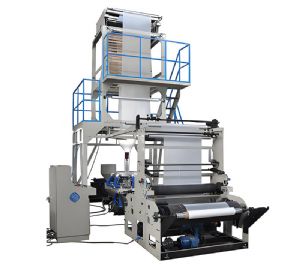
Blown Film Machine
Practical steps to calculate and set BUR during production: first, measure the lay-flat width using a ruler at the collapsing frame or after the nip. Record the die diameter from the machine specifications. Apply the formula to get the current BUR. If you need to change the target width, calculate the required BUR. Then adjust the internal bubble pressure by opening or closing the air inlet valve – wait 30 seconds for the bubble to stabilize, then measure the lay-flat again. Repeat until the target width is achieved. Remember that changing BUR also affects film thickness; for a given extruder output, higher BUR spreads the same mass over a larger area, reducing thickness. So you may need to adjust the haul-off speed (line speed) to compensate. For example, if you increase BUR from 2.5 to 3.0, the film becomes thinner; to maintain the same thickness, you need to increase extruder output or decrease line speed. Therefore, BUR adjustment should be done in coordination with output and speed controls. Many modern lines have an automatic lay-flat control that adjusts internal air pressure based on a width sensor, maintaining the set BUR automatically. The operator only needs to input the target lay-flat width.
Common mistakes: confusing BUR with draw ratio (haul-off speed divided by die exit speed). Draw ratio controls MD orientation, while BUR controls TD orientation. Both must be balanced. Another mistake is measuring the lay-flat width before the film is fully relaxed; the film may shrink slightly after winding, so measure at the collapsing frame for consistency. Also, ensure the bubble is symmetrical – if one side is larger, the BUR is not uniform, causing gauge bands. Use a bubble cage to stabilize. The frost line height also affects the effective bubble diameter; measure at a consistent height (usually at the frost line). For thick films, the bubble may have a slight taper; use the average diameter. In summary, calculating BUR is straightforward with the formula, but successful application requires understanding its impact on properties and integrating it with other process parameters. Regular monitoring and adjustment of BUR is a daily task for blown film operators to maintain product specifications and quality.
