High-speed automatic blown film line
A high-speed automatic blown film line is a state-of-the-art production system designed to operate at speeds exceeding 150 m/min, with some reaching 300 m/min or more, while incorporating extensive automation to minimize operator intervention. These lines are used for high-volume commodity films like grocery bags, produce bags, shrink wrap, and stretch film, where output per hour is the primary profitability driver. The extruder is equipped with high-torque motors and barrier screws optimized for high throughput; the cooling system is oversized – high-capacity air rings with chilled air and IBC are essential to remove heat rapidly at high speeds. The die is often of the oscillating type to average out gauge variations, and the thickness gauge is fast-scanning with AGC that can correct within milliseconds. The collapsing frame and nip rollers are servo-driven for precise speed control. The winder is a fully automatic turret type with automatic roll transfer, core loading, and roll unloading, allowing continuous operation without stopping for roll changes. The line is controlled by a centralized PLC with recipe management, enabling rapid changeovers between products.
The automation features of a high-speed line include automatic bubble pressure control that adjusts internal air to maintain constant lay-flat width as speed changes; automatic gauge control that fine-tunes the die gap via thermal bolts based on thickness profile feedback; automatic tension control on the winder to prevent telescoping; and automatic edge trim recycling that granulates and conveys trims back to the extruder feed. Many lines also include a camera-based defect detection system that identifies gels, holes, or black specks and marks them for removal. The entire system can be monitored remotely via IIoT, and predictive analytics alert operators to potential issues like bearing wear or heater failure. The line's overall equipment effectiveness (OEE) is typically above 90% due to reduced downtime. The line speed is limited by the extruder output and cooling capacity; for thin films (10-20 µm), speeds of 250-300 m/min are achievable; for thicker films (50 µm), speeds drop to 100-150 m/min. The resin must have high melt strength to withstand the high draw; LLDPE and mLLDPE are common.
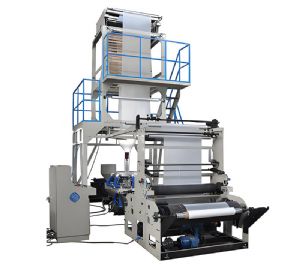
Blown Film Machine
Key technical aspects: the extruder screw diameter is often 90-150 mm, with L/D 30-36:1 for high melting capacity. The gearbox must provide high torque at high speeds. The die diameter is selected for the target lay-flat width; oscillating dies are used to spread gauge variations. The air ring is a high-efficiency dual-lip type, often with adjustable vanes to fine-tune cooling. IBC is mandatory for speeds above 150 m/min. The thickness gauge uses fast X-ray or beta technology with scan rates up to 100 Hz. The AGC actuators must respond within 0.1 seconds. The winder has a turret with two or three winding stations, enabling automatic roll changes at full speed. The edge trim system includes a granulator and a blower to return material. The control system has a touchscreen HMI with graphical trend displays and alarm history. The line's energy consumption is a key metric; high-speed lines use premium efficiency motors and sometimes heat recovery. Maintenance is scheduled based on run hours; automatic lubrication systems are common. The line's footprint is larger due to the extended cooling zone and the tall bubble tower (often 10-15 meters).
Economic benefits: high-speed automatic lines reduce labor costs (fewer operators), increase output per floor space, and improve consistency due to automation. The capital cost is 30-50% higher than a standard line, but the payback is often within 2-3 years due to higher productivity. They are ideal for converters with large, stable demand for a limited range of products. The line can also produce multiple widths by changing dies, but changeovers take 1-2 hours. The operators must be trained to handle the high-speed dynamics; sudden speed changes can cause bubble breakage. The resin quality is critical – inconsistent MFI or moisture can cause surging. Many lines are integrated with ERP systems for real-time production tracking. The trend is toward even higher speeds using advanced screw designs and improved cooling. Overall, the high-speed automatic blown film line represents the peak of efficiency for commodity film production, delivering unmatched output with minimal waste and labor, making it a cornerstone of large-scale flexible packaging manufacturing.
