Haul-off speed
Haul-off speed is the speed at which the film is pulled away from the bubble by the nip rollers, measured in meters per minute (m/min). It is essentially the line speed and is one of the primary variables for controlling film thickness. For a given extruder output (kg/h) and a given lay-flat width, the film thickness is inversely proportional to the haul-off speed: doubling the speed halves the thickness. Therefore, operators use haul-off speed as the main adjustment to achieve the target thickness. The speed is set by the rotational speed of the nip rollers (rubber and chrome rolls) that grip the collapsed film. The nip rollers are driven by a variable-frequency motor, and their speed is controlled by the operator or automatically by the line control system. Typical haul-off speeds range from 10 m/min for thick films (200+ µm) up to 300 m/min for very thin films (10-20 µm). The achievable speed is limited by the extruder's maximum output, the cooling capacity, and the film's melt strength – too high speed causes the bubble to stretch and break.
The haul-off speed also determines the machine direction (MD) draw ratio, which is the ratio of the haul-off speed to the melt exit speed at the die. A high draw ratio increases MD orientation, improving tensile strength and stiffness but reducing tear resistance and increasing shrink. Therefore, the speed must be balanced with the BUR to achieve the desired property balance. For example, a film with high MD strength (like strapping) will use high haul-off speed, while a film requiring high tear resistance will use lower speed and higher BUR. The haul-off speed is synchronized with the extruder screw speed – if the screw speed increases (more output), the haul-off speed must increase to maintain thickness, otherwise the film becomes thicker. Similarly, if the lay-flat width changes (due to BUR adjustment), the speed may need to be adjusted to maintain thickness. Most modern lines have a thickness gauge that provides feedback to automatically adjust the haul-off speed, but operators also use manual trim adjustments.
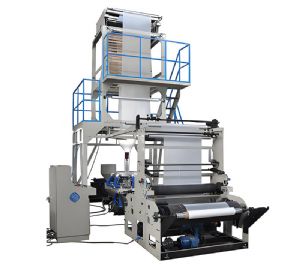
Blown Film Machine
Key parameters related to haul-off speed: the nip roller pressure (typically 2-6 bar) must be sufficient to grip the film without slipping; if the nip pressure is too low, the film slips and the actual speed is lower than setpoint, causing thickness increase. The nip roller temperature also matters – cooling the rollers can help set the film. The speed must be stable; fluctuations cause thickness variations. The speed is measured by an encoder on the nip motor; calibration ensures accuracy. The haul-off unit also includes an idler roller and a dancer arm for tension control, which must be balanced to avoid stretching or slack. The speed ramp-up during start-up must be gradual; sudden speed changes can break the bubble. The control system often has a master speed setpoint that scales all extruder speeds and haul-off speed together, maintaining layer ratios and thickness as the line speed changes.
Practical tips for haul-off speed adjustment: when changing target thickness, first calculate the required speed using the formula: New speed = Old speed × (Old thickness / New thickness). For example, to reduce thickness from 50 µm to 40 µm, increase speed by 50/40 = 1.25 times. Then make gradual changes (e.g., 5 m/min per minute) while monitoring the thickness gauge and bubble stability. If the film becomes hazy, you may have increased speed too much – reduce speed or increase cooling. Check that the winder tension is adjusted accordingly – higher speed may require higher tension to prevent telescoping. Also consider that changing haul-off speed affects the frost line height; increasing speed raises the frost line because the film spends less time cooling, so you may need to increase cooling air. For high-speed lines, ensure the air ring and IBC can handle the faster cooling demand. Regular maintenance of the nip roller drive belts and bearings prevents speed variations. In summary, haul-off speed is a fundamental control variable that must be set accurately and consistently to produce film of the specified thickness and properties. Mastery of this parameter is essential for efficient blown film production.
