Haul-off and nip roll pressure adjustment
The haul-off unit, consisting of a pair of nip rollers (rubber and chrome), serves two critical functions: pulling the collapsed film from the bubble at a controlled speed (line speed) and providing the necessary pressure to grip the film without slipping. The nip roll pressure, typically applied by pneumatic cylinders or mechanical springs, must be carefully adjusted to balance grip and film deformation. Insufficient pressure allows the film to slip, causing speed fluctuations that result in thickness variations and poor lay-flat. Excessive pressure can crush the film, creating stress marks, reducing optical clarity, or even causing the film to block (stick to itself) in the roll. The optimal pressure depends on film thickness, material stiffness, and line speed. For thin films (15-30 µm), lower pressure (2-3 bar) is sufficient; for thick films (100+ µm), higher pressure (4-6 bar) may be needed. The pressure should be equal on both sides of the nip to prevent the film from tracking (moving sideways). This is achieved by leveling the nip roll and adjusting the air pressure to each cylinder evenly. Operators should check the nip roll condition regularly – any wear, flat spots, or contamination affects grip and can cause scratches on the film. The rubber roll should be cleaned with a mild solvent and checked for hardness; a worn roll may need regrinding or replacement. The chrome roll should be smooth and free of pits.
The haul-off speed (line speed) is set by the rotational speed of the nip rollers, driven by a variable-frequency motor. The speed must be synchronized with the extruder output and the desired film thickness: for a given output, higher speed reduces thickness; lower speed increases it. The speed should be stable; any fluctuation causes gauge bands. The speed setpoint is usually entered on the HMI, and the drive system maintains it via encoder feedback. However, the actual speed can be affected by nip slip if pressure is low, or by film tension variation upstream. To adjust speed, operators monitor the thickness gauge and adjust the setpoint accordingly. When changing film thickness or width, the speed must be recalculated using the formula: New speed = Old speed × (Old thickness / New thickness) × (Old width / New width). After changing speed, the nip pressure may also need adjustment because higher speed may require more grip. Additionally, the nip roller's opening/closing mechanism should be set so that the rollers are parallel – any misalignment causes uneven pressure and wrinkling. Some lines have an automatic nip pressure control that adjusts pressure based on line speed and film thickness, using a pressure transducer feedback. This is beneficial for high-speed lines. In summary, proper haul-off and nip roll pressure adjustment ensures consistent film thickness, good lay-flat, and defect-free rolls. Regular maintenance of the nip rollers and calibration of pressure gauges are essential for stable operation.
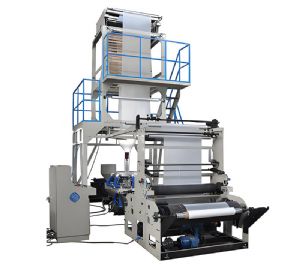
Blown Film Machine
Troubleshooting common nip issues: If the film has wrinkles entering the nip, increase pressure slightly or adjust the collapsing frame angle. If the film has marks or imprints, reduce pressure or check for debris on the roll. If the film telescopes on the winder, the nip pressure may be uneven – check and adjust. If the film slips (thickness increases unexpectedly), increase pressure or clean the rubber roll. If the film blocks (sticks to itself), pressure may be too high – reduce it. Also, the nip roll temperature can be controlled – cooling the rolls can help set the film and reduce blocking. For stretch film lines, nip pressure is critical for pre-stretch; usually set higher. Always record the pressure settings for each product recipe. The operator should visually inspect the film at the nip for any signs of slippage or distortion. Regular lubrication of the nip roll bearings and pneumatic cylinders prevents sticking and ensures smooth operation. In conclusion, nip roll adjustment is a daily task that directly impacts film quality. A systematic approach – checking pressure, alignment, and roll condition – will prevent many downstream issues.
