HDPE blown film machine
An HDPE blown film machine is a blown film extrusion line specifically designed or optimized to process high-density polyethylene (HDPE) resin. HDPE has a higher crystallinity and melting point (130-135°C) compared to LDPE, and it is more rigid, with higher tensile strength and stiffness, but lower impact resistance and clarity. HDPE film is widely used for grocery sacks, T-shirt bags, merchandise bags, liners, and agricultural mulch (thin gauge). The machine for HDPE must handle the material's narrower processing window and higher viscosity. Typically, the extruder has a high-compression screw (3:1 to 4:1) to achieve efficient melting, and the barrel temperature profile is set higher – feed zone around 170°C, metering zone up to 220°C. The die temperature is also higher (200-220°C). The bubble forming is more sensitive because HDPE has high melt elasticity; a lower BUR (2.0-2.5) is often used to maintain stability. The film is usually produced in thinner gauges (10-30 µm) for bags, and the line speed can be high (up to 150 m/min) because the film cools quickly.
The key difference in an HDPE blown film machine compared to a general-purpose PE line is the screw design – a barrier screw with a high compression ratio is essential to melt the highly crystalline HDPE. The barrel must have powerful heating and cooling zones to prevent degradation (HDPE degrades above 240°C). The die gap is typically narrower (0.8-1.2 mm) to reduce the draw-down ratio required. The air ring cooling must be efficient because HDPE film requires rapid quenching to minimize haze and maximize gloss; a dual-lip air ring is common. IBC is beneficial for high-output lines to increase cooling. The collapsing frame and nip rollers must handle the stiffer film without crushing it. The winder tension must be carefully controlled – HDPE film is less stretchy, so low tension prevents deformation. The machine often includes a corona treater because HDPE has low surface energy, requiring treatment for printing. The line can also produce HDPE/LLDPE blends for balanced properties, but pure HDPE lines are dedicated for cost-sensitive applications.
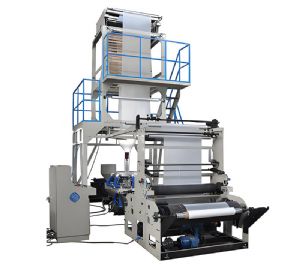
Blown Film Machine
Key parameters for HDPE blown film: melt flow index (MFI) typically 0.5-2.0 g/10 min for film grade; higher MFI improves flow but reduces mechanical strength. The BUR is usually 2.0-2.5, because higher BUR leads to bubble instability and excessive TD orientation that reduces tear strength. The frost line height is lower (300-400 mm) due to fast crystallization. The thickness tolerance is critical – HDPE film is used for lightweight bags where material savings matter, so tight gauge control reduces cost. The line output is often lower than LLDPE lines of similar extruder size because HDPE has higher density and requires more energy. Screw speed is typically 80-120 RPM. The film's mechanical properties: tensile strength (MD) 30-40 MPa, tear strength (TD) relatively low (10-20 g/µm), which is why HDPE bags are easily torn in the transverse direction – adding LLDPE blend improves this. Applications: T-shirt bags (most common), grocery sacks, trash bags (thin), produce bags, and industrial liners. The machine can also produce colored or printed film using masterbatches.
Operational tips for HDPE film production: pre-dry the resin? HDPE is not hygroscopic, so drying is usually unnecessary. However, ensure the hopper is clean to avoid contamination. Start with a conservative temperature profile and adjust based on melt pressure. Use a melt pump for stable flow. The die lip must be meticulously clean – any residue causes die lines that are very visible in thin HDPE film. Regularly check the air ring for symmetric cooling; asymmetry causes gauge bands. For recycling, HDPE film can contain post-consumer recycle (PCR) but it lowers clarity and strength; a maximum of 30% PCR is typical. The line should be purged with LDPE when shutting down to prevent HDPE from crystallizing in the screw. The winder rolls should be soft to avoid blocking; anti-block additives are often used. With proper settings, an HDPE blown film machine can produce high-quality, low-cost film for the packaging industry. The demand for HDPE film continues to grow due to its recyclability and strength-to-weight ratio, making it a sustainable choice for many applications.
