Greenhouse film blowing equipment
Greenhouse film blowing equipment is a specialized blown film line designed to produce heavy-duty agricultural films used as greenhouse covers, with a service life of 3 to 5 years or more. These films are typically 80-200 microns thick, up to 16 meters in lay-flat width (often split into two sheets), and require exceptional UV stability, thermal retention, anti-drip (condensation control), and light diffusion properties. The machine is usually a 3-layer or 5-layer co-extrusion line to incorporate different functional layers: an outer layer with high UV absorbers, a core layer with thermal additives (infrared retention), and an inner layer with anti-drip surfactants. The extruders are sized to produce high output (300-600 kg/h) because greenhouse film is produced in large volumes. The die diameter is large (up to 800 mm) for wide films. The cooling system is heavy-duty with IBC to handle the thick film and high output. The line speed is moderate (30-60 m/min) due to thickness. The winder must handle massive rolls, often with automatic roll transfer.
The key to greenhouse film production is the precise compounding of additives – UV stabilizers (HALS and UV absorbers), thermal stabilizers, anti-fog agents, and light diffusion agents. These are added as masterbatches via gravimetric feeders. The extruder screw must provide excellent mixing to ensure homogeneous distribution, as any additive agglomeration causes weak spots or poor performance. The film's optical properties – haze and light transmission – are critical; high light diffusion (to scatter sunlight and reduce shadowing) is often preferred. The film must also resist the effects of agrochemicals and temperature extremes. The 3-layer structure is common: top layer with high UV protection and dust resistance, core with thermal retention, and inner with anti-drip. The tie layers are not needed if all layers are PE-based. The bubble stability is crucial due to the large size; the air ring and IBC must be precisely controlled. The thickness gauge with AGC ensures uniform thickness to avoid weak areas.
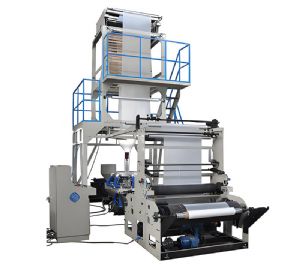
Blown Film Machine
Key technical parameters: melt temperature 190-220°C; BUR 2.5-3.5; frost line height 500-800 mm; die gap 1.5-2.5 mm. The film's mechanical strength – tear and impact – must be high to withstand wind and hail. The line often includes an in-line corona treater for further processing. The edge trim system recycles the trims. The quality control includes tests for UV degradation (accelerated weathering), tensile strength, and optical properties. The machine's control system stores recipes for different film types (clear, white, light-diffusing). The maintenance is similar to other heavy-duty lines but requires careful cleaning of the die to avoid additive deposits. The screw and barrel must be abrasion-resistant due to additives. The line's energy consumption is high; using efficient blowers and motors helps reduce costs.
Market and operational insights: greenhouse film production is concentrated in regions with large commercial farming (China, Europe, Americas). The demand is growing with protected agriculture. Converters need to offer films tailored to local climates – tropical areas require different additives than temperate. The machine is a significant investment (often over $1M) but the margins are healthy due to the value-added nature. The line can also produce other agricultural films (mulch, silage) with recipe changes. The operator must be trained to handle the large bubble and thick film; any instability can cause costly downtime. Regular calibration of the UV meter and thickness gauge is essential. The trend is toward longer-life films (5+ years) using advanced stabilizers, and also biodegradable greenhouse films for temporary covers. The machine must adapt to new resin grades. Overall, greenhouse film blowing equipment is a specialized but essential asset for the horticultural industry, enabling efficient crop production under controlled conditions. Its complexity and cost are justified by the high value of the final product and the long-term relationship with growers.
