Garment / shopping bag film line
A garment / shopping bag film line is a blown film extrusion system dedicated to producing thin films (15-30 microns) that are converted into bags for retail and clothing stores. These bags are typically made from LDPE, LLDPE, or blends, and are often printed with store logos. The line is usually a high-speed single-layer or 3-layer machine with output capacities of 150-400 kg/h and line speeds up to 200 m/min. The extruder has a barrier screw, and the die is sized for lay-flat widths of 300-1200 mm. The film is collapsed, passed through a thickness gauge, and then fed into a bag-making attachment (often integrated) that folds, heat-seals, and perforates the bags. The bags can be flat or gusseted (side gussets for more capacity). The most common type is the T-shirt bag (with handles). The line includes a corona treater for printing, and an in-line flexo printer is common to print graphics. The film may have additives like slip and anti-block to improve handling. The winder produces rolls of finished bags stacked or wound. The control system synchronizes extrusion and bag-making. The maintenance is similar to other thin-film lines, with regular die cleaning and printer maintenance.
The key factors for this line are high speed, consistent thickness, and good print quality. The film must have high clarity for product presentation. The use of LLDPE provides strength but reduces clarity; LDPE is added to improve clarity. The screw must provide homogeneous melt to avoid gels that ruin prints. The air ring must be efficient to stabilize the bubble at high speed. The thickness gauge with AGC is critical to maintain tolerance; any variation causes bag dimension changes and weak seals. The bag-making section includes a folding board, heat seal bars, and a cutting/perforating unit. The heat seal temperature and pressure must be optimized for the film. The line can produce multiple lanes (up to 4) to increase output. The printer (flexo) is synchronized with line speed. The edge trim is recycled. The line's automation includes automatic bag counting and stacker. The operator must monitor bag dimensions, seal integrity, and print registration. The line can change over to different bag sizes in 30-60 minutes.
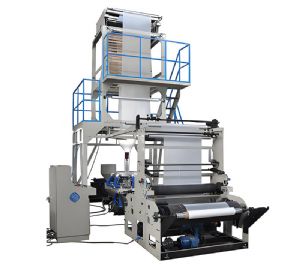
Blown Film Machine
Key technical parameters: film thickness 15-30 µm; lay-flat width 300-1200 mm; line speed up to 200 m/min; BUR 2.5-3.5; melt temperature 180-210°C. The seal strength must be adequate for the bag's load. The print quality is measured by registration and color density. The film's tear strength is important for resistance to rips. The line often includes a static eliminator to prevent dust attraction. The bag-making section can produce bags with or without gussets, and with die-cut handles for T-shirt bags. The maintenance includes cleaning the printer plates, sealing bars, and die. The line's energy consumption is lower than heavy-duty lines. The capital cost is moderate, and payback is quick due to high volume. The film can be made with recycled content (up to 30%) to reduce cost, but it may affect clarity and printability.
Market and operational insights: garment and shopping bags are high-volume commodities with low margins. Efficiency is key. The integrated line reduces handling and labor. The demand is strong from retail, fashion, and grocery sectors. The trend is toward reusable bags, but thin disposable bags remain in use in many regions. Some lines are switching to biodegradable resins (PLA, PBAT) to meet regulatory bans, requiring modified screw and temperature settings. The line's flexibility to produce different bag styles is a competitive advantage. The operator must be skilled in quick changeovers. The quality control includes checking bag dimensions, seal strength, and print clarity. The line can also produce produce bags (perforated rolls) with modifications. Overall, the garment / shopping bag film line is a classic converting line that efficiently produces millions of bags per day, serving a ubiquitous need in retail and everyday life. Its technology is mature but continues to evolve with printing and material innovations.
