Garbage / trash bag production line
A garbage / trash bag production line is an integrated system that combines a blown film extruder with downstream bag-making equipment to produce finished waste bags in one continuous process. The line starts with a blown film extruder (typically single-layer or 3-layer) producing film in a tubular form, which is then folded, sealed, perforated, and cut into individual bags. The film is usually made from LDPE, LLDPE, or blends with recycled content, ranging from 10 to 60 microns thick. The extruder is optimized for high-speed, high-output production, often with a barrier screw and a high-efficiency air ring. The die is circular, and the bubble is cooled by air. The film is collapsed and passed through a thickness gauge, then fed into a bag-making machine that includes a folding board, sealing bars (heat or ultrasonic), a perforating cutter, and a winder or stacker. The line speed can reach 150-200 m/min for thin bags. The output capacity is typically 200-500 kg/h, and the line can produce bags in various sizes (from small grocery bags to large contractor bags).
The key advantage of a fully integrated line is the elimination of intermediate roll storage and handling, reducing labor and waste. The film extrusion and bag-making are synchronized; the extruder's output matches the bag-making speed. The control system coordinates both sections. The bag-making section includes a gusseting station to create side gussets (common in T-shirt bags). The sealing system uses heated bars to create a bottom seal, and a perforating knife creates tear-off lines. The bags are then stacked or wound in rolls. The line can handle up to 4 lanes of bags simultaneously. The extruder's screw must provide consistent melt quality; any surging causes bag thickness variations. The cooling must be uniform to prevent gauge bands that cause weak seals. The line often includes a reclaim system for edge trim and rejected bags. The bag-making machine is adjustable for bag length and width. The operator can change over to different bag sizes in 30-60 minutes. The line's automation includes automatic bag counting and packing. The maintenance involves regular cleaning of the die and sealing bars; the perforating blade must be sharp.
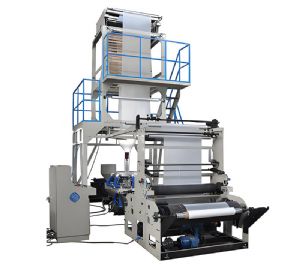
Blown Film Machine
Key technical parameters for the extrusion section: screw diameter 60-120 mm, L/D 28-32:1, output 150-500 kg/h, die diameter 200-500 mm, BUR 2.5-3.5, film thickness 10-60 µm. For the bag-making section: sealing temperature 120-180°C, sealing time 0.5-2 seconds, perforating pitch (bag length) adjustable 200-1200 mm, number of lanes 1-4. The film's properties – tear strength, puncture resistance, and seal strength – are critical. The use of recycled content (up to 50%) is common for cost reduction, but it may reduce strength and cause black specks; a fine screen pack is used. The line's energy consumption is moderate; heat recovery from the extruder can warm the sealing bars. The maintenance schedule includes cleaning the extruder screw, changing screens, and lubricating the bag-making mechanisms. The operator must monitor bag dimensions and seal integrity regularly. The line can also produce drawstring bags with an additional attachment station.
Market and operational insights: garbage bag production is a high-volume, low-margin business. Efficiency is paramount. The integrated line reduces handling and labor, improving profitability. The trend is toward thinner bags with enhanced strength using advanced LLDPE, reducing material cost and environmental footprint. Biodegradable bags are growing but still a niche. The line's flexibility to produce different bag styles (flat, gusseted, drawstring) is a competitive advantage. Many lines are installed in developing countries where labor costs are low, but automation is increasing. The capital investment for a complete integrated line is significant (often $300k-$800k), but the payback is quick due to high output. The operator must be trained in both extrusion and bag-making. Quality control includes testing bag drop impact, seal strength, and dimensions. The line can also be integrated with printing units for branded bags. Overall, the garbage bag production line is a classic example of efficient converting, turning raw resin into finished products in one continuous operation, serving a massive global market for waste management.
