Frost line height
The frost line height (FLH) is the vertical distance from the die exit to the point where the molten bubble solidifies into a solid film, typically visible as a distinct line where the bubble changes from glossy (melt) to hazy or matte (solid). This transition occurs because the polymer cools below its crystallization or glass transition temperature. The frost line height is a critical indicator of the cooling efficiency and bubble stability in blown film extrusion. A properly set frost line ensures that the bubble is fully solidified before reaching the nip rollers, preventing sticking or blocking. Typical frost line heights range from 200 mm (for thin films with high cooling) up to 1000 mm or more (for thick films with slow cooling). The height is influenced by the cooling air flow rate, air temperature, melt temperature, output rate, line speed, and BUR. Operators monitor FLH visually or with sensors (ultrasonic or optical) and adjust the air ring blower speed, die temperature, or haul-off speed to maintain it within a target range.
The frost line height directly affects film properties: if the FLH is too low (too close to the die), the film cools too quickly, which can trap orientation and cause high haze, low clarity, and reduced tear strength because molecular relaxation is limited. Conversely, if the FLH is too high (far from the die), the bubble remains molten for a longer time, allowing more orientation relaxation, which improves clarity and tear strength but may cause bubble instability (neck-in, oscillation) and reduced output due to slower cooling. For high-clarity films (e.g., packaging), a higher FLH is preferred (around 500-700 mm) to allow the polymer chains to relax and reduce haze. For high-strength films (e.g., shrink or agricultural), a lower FLH (300-400 mm) can freeze in orientation, improving mechanical properties. However, the FLH also depends on resin type – LLDPE requires faster cooling and thus lower FLH compared to LDPE. The FLH is also related to the bubble shape; a stable bubble has a cylindrical section below the frost line and a slight taper above it.
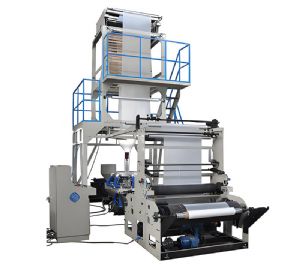
Blown Film Machine
Factors affecting frost line height: cooling air volume (higher flow lowers FLH), air temperature (colder air lowers FLH), melt temperature (higher melt raises FLH because more heat to remove), line speed (faster speed raises FLH because less time for cooling), output (higher output raises FLH due to more heat), and BUR (higher BUR typically raises FLH because larger bubble surface area but thicker film). To control FLH, operators adjust the blower frequency (air flow) and sometimes the air ring angle or lip gap. For lines with IBC, internal cooling air also affects FLH; increasing internal air flow reduces FLH by cooling from inside. In automatic control systems, FLH is often used as a feedback variable to adjust cooling air to maintain a setpoint. However, measuring FLH automatically is challenging; many lines rely on manual observation with a scale or camera. Some advanced systems use machine vision to detect the frost line and feed back to the blower speed.
Practical tips for frost line management: during start-up, set the cooling air to a moderate level and observe the bubble; the frost line should be visible and stable. Adjust air flow until the line is at the desired height. Avoid rapid changes that cause the frost line to jump, which leads to gauge variation. The frost line should be uniform around the circumference – if one side is higher, it indicates uneven cooling or die temperature, which requires cleaning or adjusting the air ring. The distance from die to nip rollers must be sufficient to accommodate the FLH; if the FLH exceeds that distance, the film will be molten at the nip, causing blocking and sticking. For thick films, you may need to reduce line speed or increase cooling. Also, seasonal changes in ambient temperature affect FLH; in summer, you may need more cooling air. Regular cleaning of the air ring and die lip ensures consistent cooling. In multi-layer films, each layer has different crystallization rates, so the effective FLH may be determined by the slowest-cooling layer. Overall, frost line height is a practical and essential parameter that operators must constantly monitor and adjust to achieve the desired balance between film quality and production rate. Mastering FLH control is a hallmark of skilled blown film operators.
