Frost line height adjustment tips
Frost line height (FLH) is the vertical distance from the die exit to the point where the molten bubble solidifies, visible as a distinct line. Adjusting FLH is a primary tool for controlling film properties such as clarity, strength, and gauge uniformity. A lower FLH (closer to die) means faster cooling, which freezes orientation, increases haze, and reduces clarity, but improves mechanical strength (tear and impact) and allows higher line speeds for a given output. A higher FLH (farther from die) allows more relaxation, improving clarity and gloss, but reduces mechanical strength and may cause bubble instability. The ideal FLH depends on the application: for high-strength films (e.g., shrink, agricultural), a low FLH (300-500 mm) is preferred; for high-clarity films (packaging), a higher FLH (500-800 mm) is better. The adjustment is typically done by changing the cooling air flow from the air ring – increasing air flow lowers the FLH, decreasing raises it. IBC (internal bubble cooling) also affects FLH – increasing internal cooling lowers FLH. The operator must balance FLH with line speed and output; changing one affects the others. To adjust FLH, start by noting the current height (use a scale or laser). If you need to lower it, increase the air ring blower speed or open the air ring damper. If using IBC, increase the internal air flow. Wait 30-60 seconds for the bubble to stabilize, then measure the new FLH. Repeat until target height is achieved.
Practical tips: always adjust FLH gradually – large changes can destabilize the bubble. When increasing cooling, also monitor the bubble diameter (lay-flat width) – more cooling can cause the bubble to shrink slightly, so you may need to adjust internal pressure to maintain width. The relationship between FLH and film thickness is indirect: lowering FLH (faster cooling) tends to reduce gauge variation because the freeze line is more stable, but if cooling is too aggressive, the film may become brittle. Also, note the ambient temperature and humidity – on hot days, the same air flow gives a higher FLH (because air is less dense), so you may need to increase airflow or use chilled air. Conversely, in winter, reduce airflow. Use a frosted line indicator – a small string or a smoke pencil can show air flow patterns. If the frost line is uneven (higher on one side), it indicates asymmetric cooling – clean the air ring vanes and check for obstructions. Uneven FLH causes gauge bands. Another tip: when changing line speed, FLH will shift – increasing speed raises FLH (less cooling time), so you need to increase cooling to bring it back. Therefore, always adjust FLH after changing speed. For thick films, FLH is naturally higher because more heat is in the bubble; you may need maximum cooling. For thin films, FLH can be lower. Some operators prefer to maintain a constant FLH for each product, adjusting cooling with speed changes. Advanced lines have an automatic FLH control using a camera and a blower speed feedback loop – this simplifies operation.
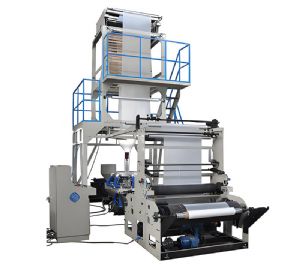
Blown Film Machine
Step-by-step adjustment procedure: 1) Determine target FLH based on product specification (refer to previous runs). 2) Ensure the air ring is clean and centered. 3) Start with blower at 60% speed. 4) Observe bubble – if frost line is too high, increase blower speed by 5% and wait 1 minute. 5) Measure FLH; repeat until target is reached. 6) If FLH is too low, decrease blower speed. 7) After each adjustment, check lay-flat width and adjust internal pressure if necessary. 8) Check film properties (haze, tear) after stabilization – if not satisfactory, adjust FLH further. 9) Record the final settings for future runs. When adjusting FLH for multi-layer films, remember that different layers may have different crystallization rates; the visible frost line is an average. Focus on achieving a stable, uniform line. If the bubble oscillates, reduce cooling slightly to allow more relaxation. Also, if you have IBC, you can use it to fine-tune FLH independent of external air – e.g., increase IBC to lower FLH without changing external air flow, which helps if external air causes turbulence. Finally, always document the FLH and corresponding settings in the recipe. Regular training of operators on FLH adjustment is important because it's a dynamic control that requires experience and intuition.
Common mistakes: adjusting FLH by changing haul-off speed – this is wrong; haul-off speed affects thickness, not cooling directly. Changing melt temperature – higher melt temperature raises FLH; but adjusting melt temperature for FLH alone is not recommended because it affects many properties. Instead, use cooling air. Also, avoid touching the bubble when measuring FLH – you can cause a disturbance. Use a non-contact method like a laser pointer or a scale with a sightline. If the frost line is invisible (for some resins), use an infrared temperature spot meter to find the solidification point. In summary, frost line height adjustment is a delicate balance that requires attention to cooling, speed, and material. With practice, operators can quickly set the optimal FLH for each product, ensuring consistent quality and stable production.
