Film blowing machine
A film blowing machine, often used interchangeably with blown film extruder, refers to the entire production line from hopper to winder. The heart of the machine is the circular die that extrudes a molten tube, which is then inflated by internal air pressure to form a bubble. The bubble diameter is controlled by the blow-up ratio (BUR), typically between 1.5:1 and 5:1, which determines the final lay-flat width and imparts transverse direction (TD) strength. The bubble is stabilized by an air ring that directs cooling air onto the melt surface, setting the frost line height where the film solidifies. Operators adjust the air ring velocity and temperature to achieve uniform cooling and prevent bubble oscillation.
The film blowing machine includes several auxiliary components: a collapsing frame that gradually flattens the bubble into a double-layer sheet, nip rollers that pull the film and set the line speed, and a winding unit that rolls the finished film onto cores. The nip roller speed, in conjunction with the extruder output and bubble air volume, determines the final film thickness. Thinner films require higher take-up speeds and lower output, while thicker films need slower haul-off. A thickness gauge (often beta or infrared) installed between the nip and winder continuously monitors gauge and provides feedback to the die's auto-profiling system to adjust the die gap or air ring distribution. For high-end lines, internal bubble cooling (IBC) is integrated to circulate chilled air inside the bubble, enhancing cooling efficiency and allowing higher throughput without increasing bubble height.
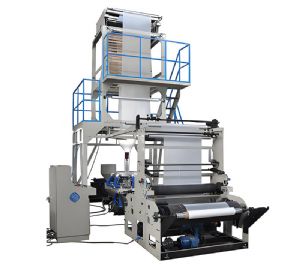
Blown Film Machine
Key operating parameters for a film blowing machine include blow-up ratio, frost line height, bubble internal pressure, and cooling air flow rate. The frost line should be stable and typically located 300–800 mm above the die. Variations in frost line cause thickness fluctuations and haze. Modern machines employ automatic bubble control systems that adjust internal pressure and haul-off speed to maintain constant lay-flat width. The air ring design – single-lip, dual-lip, or with adjustable vanes – significantly influences film optical and mechanical properties. Additionally, the collapsing frame angles and nip roller pressure must be set to avoid wrinkles and ensure uniform flat film. The winder tension control is equally critical; excessive tension stretches the film, reducing thickness, while low tension causes telescoping rolls.
In terms of line configurations, film blowing machines come in single-station or dual-station winders, surface or center winding modes, and with or without in-line slitting. For high-output lines, the machine may include an edge trim recycling system that conveys trimmed edges back to the extruder feed. The line can be equipped with corona treating units to increase surface energy for printing or laminating. For multi-layer films, a film blowing machine has multiple extruders feeding a co-extrusion die; layer distribution is controlled by each extruder's screw speed and the feed block design. Typical layer structures include A/B/A symmetrical or A/B/C functional layers for barrier properties. Safety features such as emergency stops, interlocks, and melt pressure relief valves are mandatory. With proper setup, a film blowing machine can run continuously for weeks, producing consistent high-quality film for packaging, agriculture, and industrial uses. Regular cleaning of the die lip, air ring, and nip rollers prevents defects like die lines and gels. Overall, the film blowing machine is a versatile workhorse in the plastics converting industry.
