Die diameter (mm)
The die diameter is one of the most critical specifications for a blown film line, as it directly determines the maximum lay-flat width of the film and influences output capacity, bubble stability, and mechanical properties. Measured in millimeters (mm), the die diameter refers to the outer circumference of the circular die lip from which the molten polymer exits. Common die diameters range from 50 mm for small laboratory or narrow-film lines up to 800 mm or more for wide agricultural or industrial films. The relationship between die diameter and final film width is governed by the blow-up ratio (BUR): lay-flat width ≈ π × die diameter × BUR / 2 (for standard collapsing). For example, a 200 mm die with a BUR of 3:1 produces a lay-flat width of about π×200×3/2 = 942 mm (approximately). Therefore, to produce a 2-meter wide film, a die of about 400-450 mm with BUR around 2.5-3.0 is typically used. Choosing the right die diameter involves balancing desired width, available extruder output, cooling capacity, and film property requirements.
A larger die diameter allows for wider films and higher outputs because the melt can be spread over a larger circumference, reducing the need for extreme BUR values. However, larger dies require more precise temperature control to maintain uniform melt distribution across the circumference – any temperature gradient leads to gauge variations. Also, larger dies cost more, take up more space, and require larger air rings and blowers. Conversely, a smaller die can produce narrower films with lower output but offers better gauge control and easier handling. For multi-layer films, the die must accommodate the feed block and layer distribution; stack-type dies with multiple spiral mandrels are common for 3-5 layers. The die gap (the opening between the inner and outer lip) is another parameter; typical gaps range from 0.5 to 2.5 mm, affecting film thickness and draw-down ratio. Die diameter is often chosen based on the desired lay-flat width range and the maximum BUR that can be stably achieved (usually 2.5-4.0 for most materials).
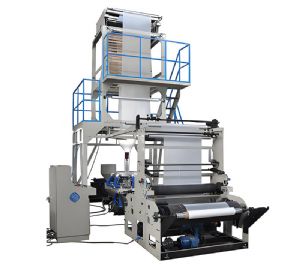
Blown Film Machine
Key factors in selecting die diameter include the target film width, available extruder output (kg/h), and the resin's melt strength. For a given output, a larger die reduces the draw-down ratio (DDR), which can improve optical clarity and reduce haze but may lower tensile properties. Conversely, a smaller die with higher BUR imparts more TD orientation, increasing tear strength but risking bubble instability. Die diameter also affects the frost line height – larger bubbles require more cooling air, and the air ring must be sized accordingly. Common die sizes by application: 50-150 mm for small bags and tubes; 200-400 mm for general packaging and trash bags; 400-600 mm for shrink film and agricultural mulch; 600-800+ mm for greenhouse film and heavy-duty industrial liners. Manufacturers often provide die diameter ranges for each line model, and custom sizes are available. When upgrading a line, increasing die diameter may require a larger extruder and blower, so it's not a standalone change. Additionally, the die material – usually tool steel or hardened stainless – must resist wear from abrasive fillers. Regular cleaning of the die lip is essential; any residue causes die lines that appear as longitudinal streaks on the film.
Practical guidelines for die diameter selection: first, define the maximum lay-flat width needed for your final product. Then, decide on a target BUR – typical values: 2.0-2.5 for high-clarity films, 3.0-4.0 for high-strength films. Calculate the required die diameter as: Die diameter = (2 × lay-flat width) / (π × BUR). For example, for 1200 mm lay-flat and BUR=3.0, die diameter = (2×1200)/(π×3) = 2400/9.42 ≈ 255 mm. Round up to standard size (e.g., 250 or 300 mm). Then ensure your extruder output can supply enough melt to fill that die at the desired speed – too little output leads to thin film and bubble collapse, too much causes thick film and excessive cooling load. Also consider the die's internal melt flow distribution – spiral mandrel dies are common for small to medium sizes, while stack dies are used for large diameters and multi-layer. The die temperature profile should be uniform within ±1°C to avoid melt fracture. Many modern dies feature adjustable die gap (via thermal expansion bolts) for fine-tuning thickness profiles. In summary, die diameter is not chosen in isolation; it must be matched with extruder size, air ring capacity, and winder width to form a balanced blown film line. Consulting with die manufacturers and using simulation software can help optimize the selection for specific resin grades and production targets.
