Cooling air ring optimization
The cooling air ring is the primary heat transfer device in blown film, responsible for solidifying the molten bubble. Its optimization is crucial for achieving high output, uniform thickness, and desired film properties (clarity, strength). The air ring directs a high-velocity stream of air onto the bubble surface; the cooling efficiency depends on air velocity, temperature, and uniformity. Optimization involves adjusting the air ring's lip gap, vane angles, blower speed, and height above the die. A dual-lip air ring provides better stability and cooling than a single-lip design because it delivers a primary and secondary air flow, allowing independent control of cooling intensity and pattern. The first step in optimization is to ensure the air ring is clean – any dirt or polymer buildup disturbs airflow. Use a brass scraper and solvent to clean the lips and vanes regularly. Next, check the air ring centering – it must be concentric with the die. Use a dial indicator to measure the gap between the die and the air ring; adjust accordingly. The blower speed (or damper setting) controls the air volume; increase it to lower the frost line (faster cooling) or decrease to raise it. However, too high air velocity can cause bubble oscillation; the optimal speed is just below the point of instability. The air temperature also matters – using chilled air (5-10°C) can increase cooling capacity by 20-30%, enabling higher line speeds. This requires a chiller and insulated ducts. The air ring height above the die affects the cooling zone; lowering it increases cooling intensity. Typically, the air ring is positioned 50-150 mm above the die; fine-tuning within this range can adjust the frost line.
Vane adjustments are critical for uniformity. Most air rings have adjustable vanes that can be angled to direct air flow. If one side of the bubble is cooler (lower frost line), open the vanes on that side or close on the opposite side. Use a smoke stick or a piece of yarn to visualize airflow; the air should hit the bubble at a tangent, not directly, to avoid turbulence. The air flow should be symmetric; any asymmetry causes gauge bands. For wide bubbles, segmented air rings with independent zone control allow finer adjustment. Some advanced air rings have motorized vanes that can be adjusted remotely via PLC. The air ring's lip gap also affects air velocity – a smaller gap increases velocity for the same volume, providing more intense cooling but with higher pressure drop. Experiment with different gaps while monitoring frost line height and bubble stability. The optimal settings depend on the resin – LLDPE requires more aggressive cooling than LDPE. Also, the output level influences air ring settings; higher output requires more cooling air. Operators should document settings for each product. In summary, cooling air ring optimization is an iterative process that balances cooling intensity, uniformity, and bubble stability. Regular cleaning, careful adjustments, and use of chilled air (when feasible) can significantly improve film quality and output.
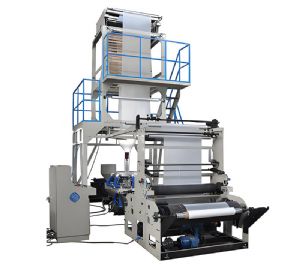
Blown Film Machine
Step-by-step optimization procedure: 1) Clean the air ring thoroughly. 2) Check and set centering. 3) Set blower to 60% of max speed and observe frost line height. 4) Adjust blower speed to achieve target frost line (e.g., 400-600 mm). 5) Use smoke test to check uniformity – adjust vanes to balance. 6) If bubble oscillates, reduce blower speed slightly or open vanes to reduce turbulence. 7) If cooling is insufficient, consider reducing air ring height by 10-20 mm. 8) If using IBC, balance internal and external cooling – increase internal air if frost line is too high. 9) Monitor film haze and clarity – if haze is too high, increase cooling (lower frost line) or use chilled air. 10) Record final settings and monitor over time. Also, check the air filter – a clogged filter reduces airflow, causing the frost line to rise. Change filters regularly. For multi-layer films, the air ring must be optimized for the layer with the highest melt temperature, as it dictates the cooling demand. In conclusion, the air ring is the "engine" of cooling; its optimization yields direct benefits in speed, uniformity, and film properties. Invest time in tuning it for each product, and you will see significant improvements in efficiency and quality.
